9 min read
What Are Paid Ads and Are They Actually Worth It for Your Business?
 Written byThomas FitzgeraldFounder, Your Digital Team
Paid mediaPublished 22 Apr 2026
What Are Paid Ads and Are They Actually Worth It for Your Business?
Paid advertising is one of those topics where you will find wildly opposing opinions. Some business owners swear by it. Others have burned through thousands of pounds and seen nothing in return. Both experiences are common, and both are completely understandable — because paid ads done well and paid ads done badly look nothing alike.
This is a straightforward breakdown of what paid advertising actually is, how the main platforms work, when it makes sense for a business to invest in it, and what separates the campaigns that deliver from the ones that drain budgets.
What Paid Advertising Actually Is
Paid advertising is exactly what it sounds like. You pay a platform to show your business to people who match a set of criteria you define. When someone clicks your ad, you pay a fee. If your campaign is set up properly, that click turns into an enquiry or a sale worth considerably more than what you paid for it. If it is not, you pay for clicks that go nowhere.
The two platforms that matter most for the majority of UK businesses are Google Ads and Meta Ads — Facebook and Instagram. They work on fundamentally different principles and serve different purposes, which is why treating them as interchangeable is one of the most common mistakes businesses make.
Google Ads: Capturing Demand That Already Exists
Google Ads puts your business in front of people who are actively searching for what you offer. Someone types "emergency electrician Leeds" into Google and your ad appears at the top of the results page. They were already looking. Your ad intercepts that existing demand and routes it toward your business instead of your competitors.
This is called demand capture, and it is extraordinarily powerful when it is done correctly. The intent is already there. You are not trying to convince someone they need something — they have already decided they need it. You are just making sure they find you first.
The main formats within Google Ads are search ads — the text listings that appear above organic results — and Performance Max campaigns, which serve ads across Google's entire network including Search, YouTube, Gmail, and the Display Network. For most service businesses, search campaigns targeting high-intent keywords are where the strongest returns come from.
Meta Ads: Creating Demand That Does Not Exist Yet
Meta Ads — running across Facebook and Instagram — work on a completely different principle. Nobody on Facebook is searching for your service. They are scrolling through their feed, looking at photos, watching videos. Your ad interrupts that experience and tries to create interest where none existed a moment ago.
This is called demand generation, and it requires a different approach entirely. Because you are reaching people who were not actively looking for you, the creative — the image or video, the headline, the copy — has to work much harder to earn attention and generate interest.
Meta Ads tend to work best for businesses with a visual product or service, a clearly defined target audience, and an offer compelling enough to make someone stop scrolling. They are also powerful for retargeting — showing ads specifically to people who have already visited your website but did not enquire, keeping your business front of mind until they are ready to take action.
How the Auction Works
Both Google and Meta use auction systems to decide which ads to show and how much advertisers pay. Understanding this at a basic level helps explain why two businesses spending the same amount can get very different results.
On Google, your position in the results is not determined purely by how much you bid. Google also considers the quality of your ad and the relevance and quality of the page you are sending people to. A highly relevant, well-structured ad pointing to a strong landing page can outrank a competitor who is bidding more but whose ad and landing page are generic and poorly matched to the search.
This means the quality of your campaign matters as much as the size of your budget. An agency that knows what they are doing can make a modest budget go significantly further than a poorly managed campaign with twice the spend.
What Makes a Paid Ads Campaign Actually Work
Targeting the right searches or audiences
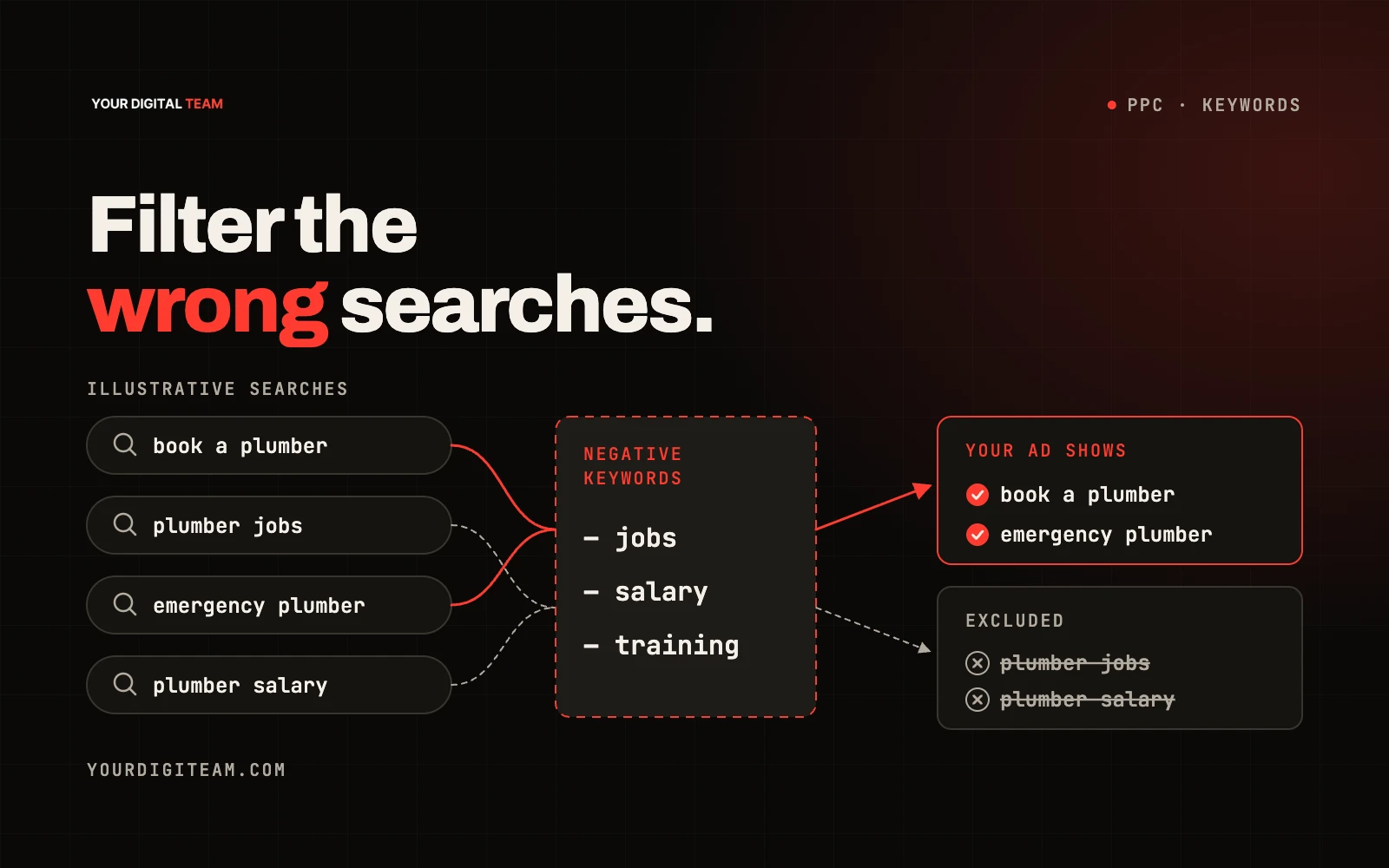
On Google, targeting too broadly is one of the fastest ways to burn a budget. If you are a commercial plumber and your ads are showing for "how to fix a leaky tap," you are paying for clicks from people who were never going to hire you. Tight, intent-focused keyword targeting is the foundation of a profitable search campaign.
On Meta, audience targeting is the equivalent lever. The platform offers an enormous range of targeting options based on demographics, interests, behaviours, and lookalike audiences built from your existing customers. Getting this wrong means paying to reach people who have no interest in what you offer.
A landing page that converts
This is where a huge proportion of ad spend is wasted. A business runs a well-targeted campaign, generates clicks from genuinely interested people, and then sends them to a homepage that is slow, unclear, and has no obvious call to action. The click was paid for. The conversion never happened.
The page someone lands on after clicking an ad should be directly relevant to what the ad promised, load quickly on mobile, communicate the key benefits clearly, and make it immediately obvious what the visitor should do next. A dedicated landing page built specifically for a campaign will almost always outperform a generic homepage.
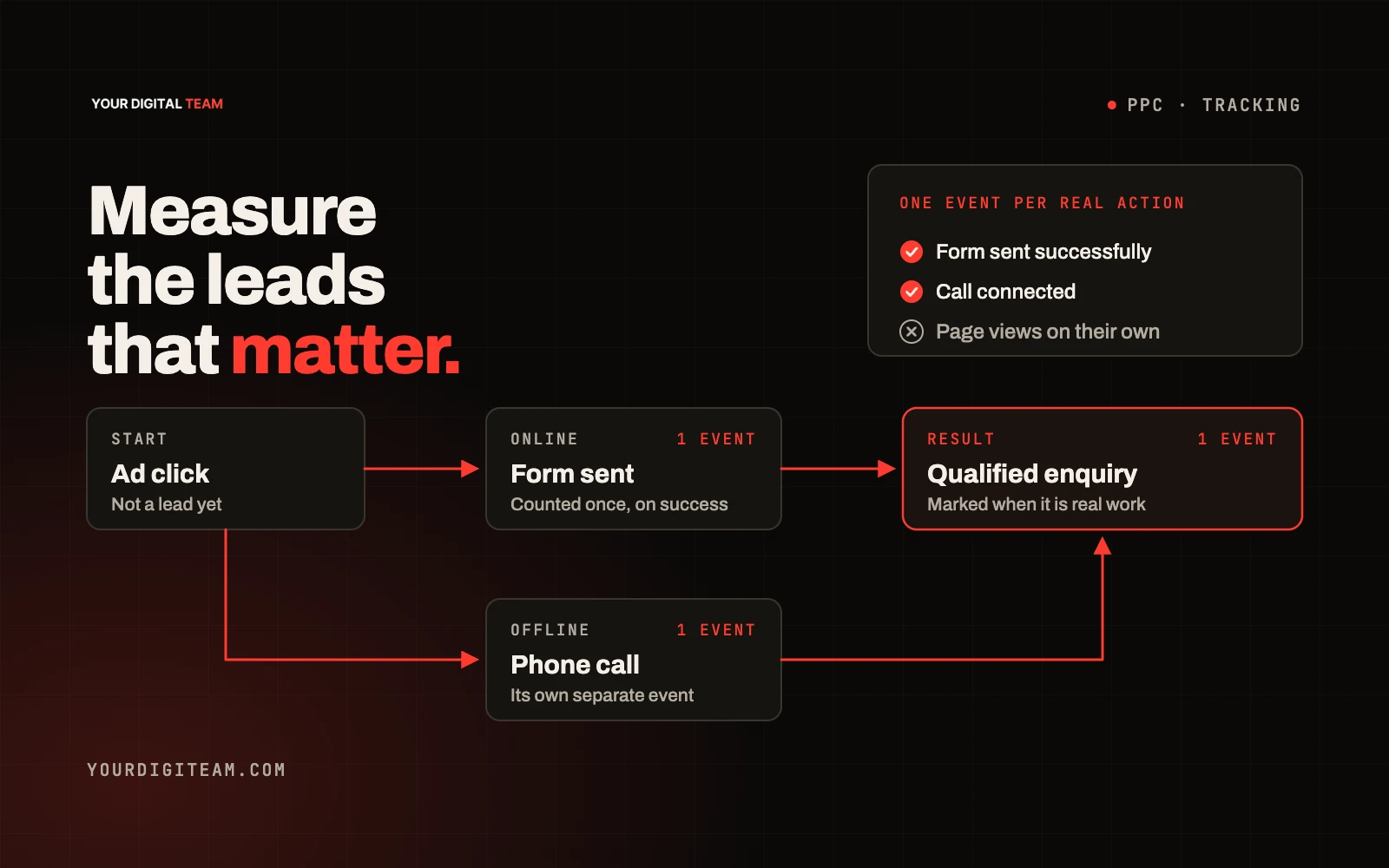
Conversion tracking
If you cannot see which keywords or audiences are generating enquiries and which are generating clicks that go nowhere, you cannot optimise your campaign. You are just spending money and hoping.
Proper conversion tracking — set up through Google Tag Manager and connected to GA4 — tells you exactly which parts of your campaign are working. That data is what allows an experienced media buyer to cut wasted spend, double down on what is performing, and continuously improve the return on your investment.
An agency that is running your paid ads without conversion tracking in place is not managing your campaign. They are managing your budget.
Continuous testing and optimisation
The best paid ads campaigns are never finished. Ad copy gets tested. Landing page headlines get tested. Audience segments get tested. Bidding strategies get refined. The campaigns that deliver strong returns month after month are the ones where someone is actively looking at the data, drawing conclusions, and making changes — not the ones that were set up once and left to run.
This is why the quality of management matters enormously. A campaign that is actively optimised by someone who knows what they are doing will consistently outperform a set-and-forget campaign regardless of how similar the initial setup looks.
When Paid Ads Make Sense and When They Do Not
Paid advertising is not the right investment for every business at every stage. Here is an honest assessment of when it makes sense.
It makes sense when you need results quickly. Unlike SEO, which takes months to build momentum, a well-structured Google Ads campaign can be generating enquiries within days of launch. If you have an immediate need for new business, paid search is the fastest legitimate path to it.
It makes sense when your margins support it. If a customer is worth £5,000 to your business and clicks in your market cost £15, the maths works comfortably even at a modest conversion rate. If a customer is worth £80 and clicks cost £12, you need a very high conversion rate to make the numbers work — and in many cases they simply will not.
It makes sense when your website can convert the traffic. Sending paid traffic to a website that does not build trust, does not communicate clearly, and does not make it easy to enquire is paying for visitors who will leave without becoming customers. Sort the website first.
It makes less sense as a standalone long-term strategy. Paid ads stop the moment you stop paying. Every customer they generate costs you something. Businesses that rely exclusively on paid advertising are perpetually dependent on their ad spend. The strongest marketing strategies use paid ads to generate short-term revenue while SEO and content build the organic presence that reduces that dependence over time.
What Bad Paid Ads Management Looks Like
Broad match keywords with no negative keyword list, meaning your budget is being spent on irrelevant searches. Generic ad copy that says nothing specific about your business or why someone should choose you. Ads pointing to a homepage rather than a dedicated landing page. No conversion tracking, so nobody knows what is working. Monthly reports showing impressions and click through rates but no data on enquiries or cost per lead.
If any of that sounds familiar, your campaigns have room for significant improvement — and the results you have seen so far are not representative of what paid advertising can actually deliver when it is managed properly.
What to Ask Before You Hand Over Your Budget
Ask any agency you are considering to show you the conversion tracking setup they would implement and explain how they report on cost per lead rather than cost per click. Ask them what their process is for negative keyword management and how frequently they review search term reports. Ask them for examples of campaigns they have run in similar industries and what the results looked like.
An agency that cannot answer those questions clearly and specifically is not ready to manage your budget responsibly.
The Bottom Line
Paid advertising is one of the most powerful tools available to a business that wants to grow. It is also one of the easiest ways to spend a significant amount of money for very little in return if it is not set up and managed properly.
The difference between those two outcomes is almost never the size of the budget. It is the quality of the targeting, the strength of the landing page, the rigour of the conversion tracking, and the discipline of the ongoing optimisation.
Done properly, paid ads generate a measurable, predictable return. Done badly, they are an expensive lesson in why execution matters more than intention.
If you want to understand whether paid advertising makes sense for your business right now and what a properly managed campaign would look like, book a free strategy call. We will look at your market, your margins, and your current setup and give you an honest answer.