11 min read
Google Ads Cost UK: Click Costs Explained
 Written byThomas FitzgeraldFounder, Your Digital Team
Paid mediaPublished 23 Sep 2026Updated
Want help putting this into practice? Explore our PPC and Google Ads management in Newcastle.
Google Ads can cost £1 a click or £30 a click. That is why “how much do Google Ads cost?” is the wrong question on its own.
There is no fixed price for Google Ads in the UK: you set your own budget and pay for clicks won in an auction. LOCALiQ's 2025 UK Paid Advertising Benchmark Report puts the average paid search cost per click at £1.72 in 2024, with solicitors the most expensive at £2.93. Startups.co.uk says a small business can expect to pay £750 to £7,500 a month for a Google campaign. Google may spend up to twice your average daily budget on a busy day, but never more than 30.4 times it in a month.
If the channel choices are unfamiliar, start with how paid ads work before comparing budgets.
The better question is: what does a click cost in your market, how many clicks become enquiries, and how many enquiries become profitable work?
01. What determines cost per click
Google Ads is an auction.
Your cost depends on competition, location, keyword intent, ad quality, landing page quality, expected click-through rate and how valuable a lead is in your industry.
A click for “emergency plumber near me” costs more than a click for “how to bleed a radiator” because the first searcher is ready to buy.
Intent is the price signal.
02. Why CPCs vary by industry
High-value leads attract higher bids.
Legal, finance, home improvement, medical, B2B and urgent trade searches often carry higher click costs because one customer can be worth a lot.
Retail, low-ticket ecommerce and broad informational searches can be cheaper per click, but they may need far more clicks before anyone buys.
Cheap clicks are not automatically better. A £2 click that never converts is more expensive than a £12 click that turns into work.
03. Realistic starting budgets
Start small enough to control, but not so small that you learn nothing.
For a local service business, £10 to £30 per day can be enough to test a narrow campaign in one area. For competitive sectors or wider locations, £50 to £100 per day gives Google more room to gather useful data.
The campaign should be tight at the start: exact services, clear location, strong negative keywords, and a landing page built for the offer.
04. Hidden costs beyond the click
The ad spend is only one part.
You may also need landing page work, tracking setup, conversion measurement, call tracking, copywriting, account management and ongoing optimisation.
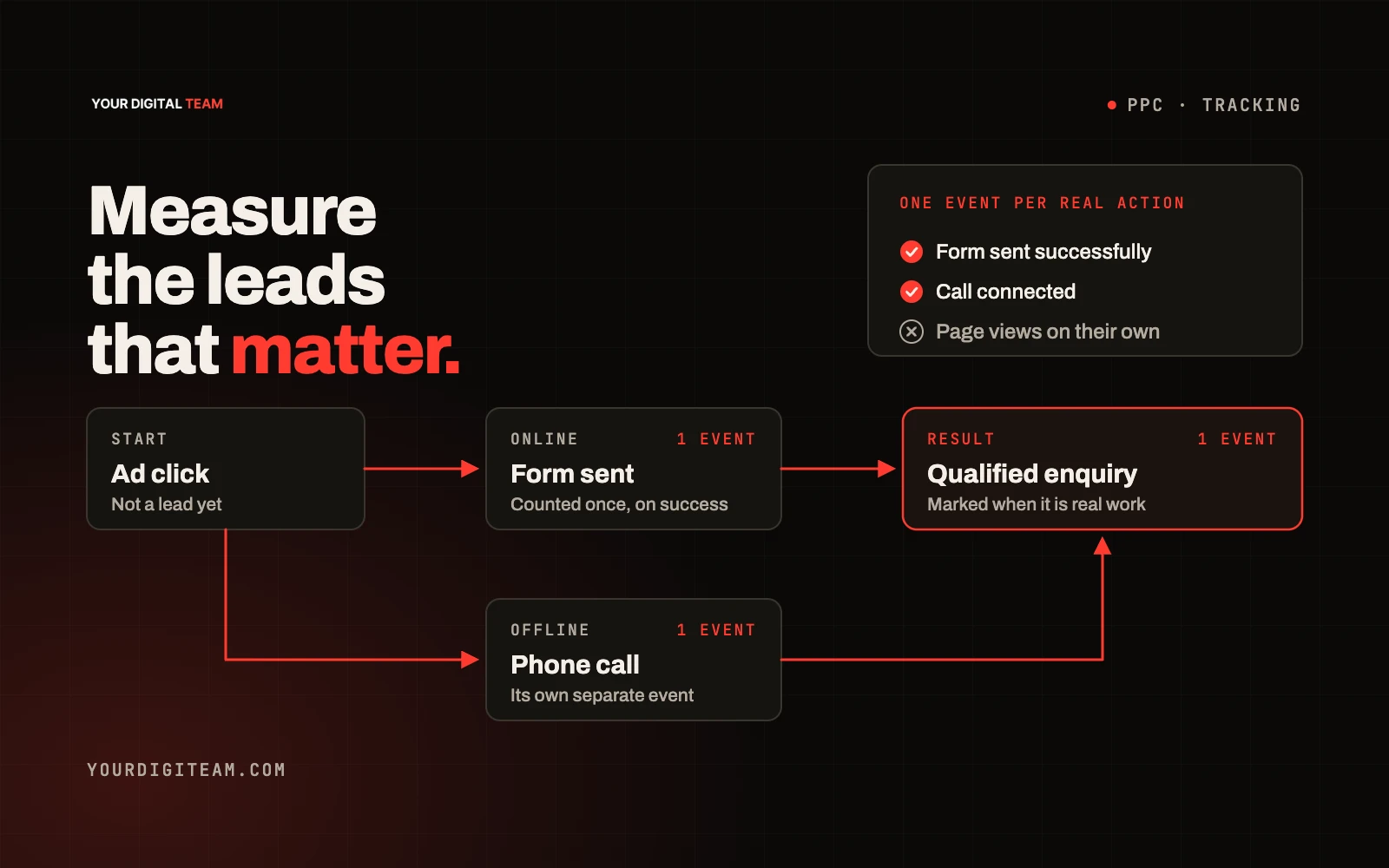
Without tracking, you are guessing. Without a strong landing page, you are paying for attention and wasting it.
05. How to keep costs down
Control the waste before chasing scale.
Use specific keywords, exclude irrelevant searches, send traffic to the right page, split campaigns by intent, write clear ads, and measure real enquiries rather than clicks.
Do not let Google spend broadly until the basics are working. Small budgets need discipline.
06. When ads are worth it
Ads work when the maths works.
If a lead costs £60 and one in four leads becomes a £1,000 job, the numbers can work. If a lead costs £120 and the average job is £150, they probably do not.
That is why we always start with the numbers before scaling a campaign.
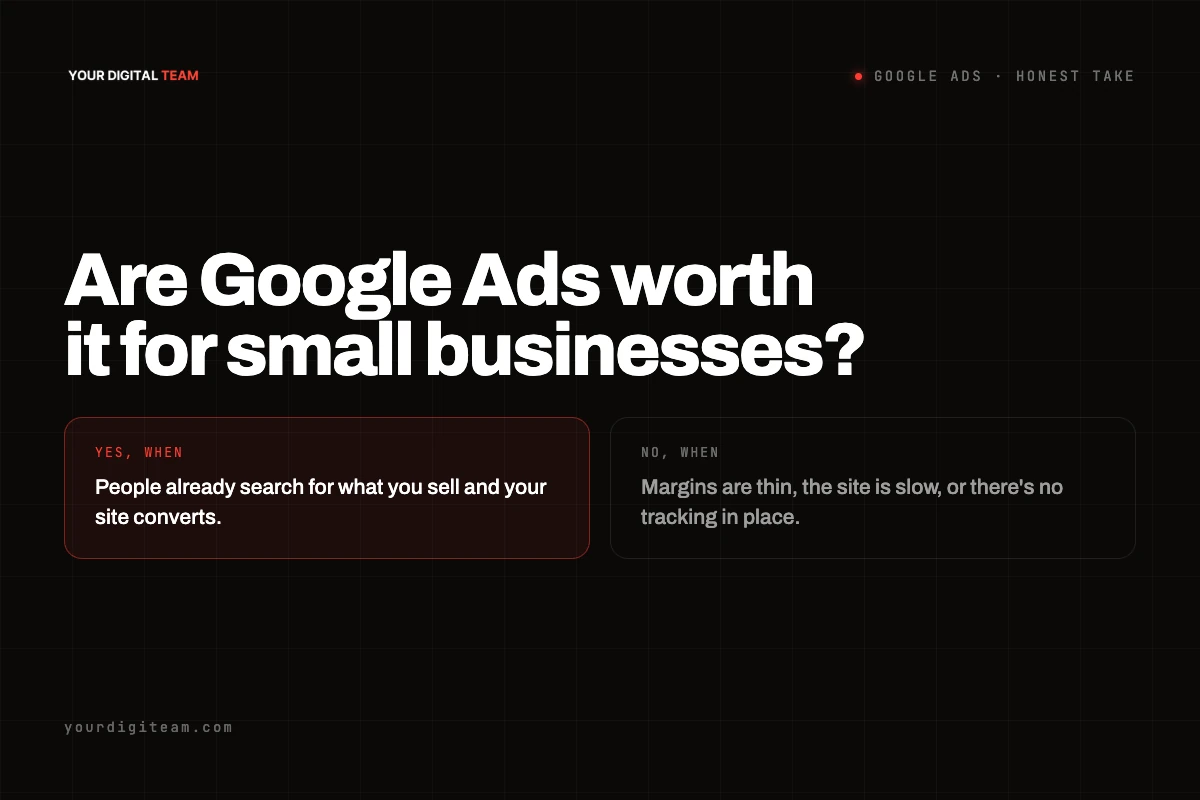
Still deciding? Read are Google Ads worth it for small businesses?
2026 update: how Google Ads pricing works
There is no price list for Google Ads. Every time someone searches, Google runs an auction to decide which ads show and in what order. Three things decide where you land and what you pay:
- Your maximum cost per click (max CPC). Google Ads Help describes this as "the most you're willing to pay for a click on your ad".
- Your actual cost per click. You rarely pay your full max bid. According to Google Ads Help, you pay only "what's minimally required to hold your Ad Rank", so the amount charged is usually lower.
- Your Quality Score. Google's UK guide to Google Ads costs says Ad Rank combines your bid, the context of the search and Quality Score, which is built from expected click-through rate, ad relevance and landing page experience. Google also says a smaller business with a highly relevant ad can still compete with a larger competitor's higher bid.
You set the budget too. Each campaign has an average daily budget, and the rules on how far it can stretch catch a lot of people out.
Daily budgets and the monthly cap
Google Ads Help says that on a given day your campaign "might spend up to twice your average daily budget", but over the month you will spend "no more than 30.4 times your average daily budget". Google uses 30.4 because it is the average number of days in a month. So a busy Tuesday can cost more than you planned, but the month as a whole stays capped.
| Average daily budget | Most you can be charged in one day | Most you can be charged in a month |
|---|---|---|
| £10 | £20 | £304 |
| £20 | £40 | £608 |
| £50 | £100 | £1,520 |
These are limits, not targets. With too few searches for your keywords, you can spend well under the cap.
Typical UK cost per click by industry
Most cost-per-click figures online are American and in dollars. The most useful UK figures we found come from LOCALiQ's 2025 UK Paid Advertising Benchmark Report, which pulled data from over 600 advertisers and more than 10,000 of its own campaign cycles across 2023 and 2024. It lists the three most expensive industries for paid search clicks each year:
| Rank | 2023 | 2024 |
|---|---|---|
| Highest CPC | Solicitors, £3.06 | Solicitors, £2.93 |
| Second highest | Finance, £2.53 | Aesthetic, £2.73 |
| Third highest | Family and personal services, £1.81 | Recruitment, £2.68 |
According to the same report, the average paid search cost per click across all industries was £1.72 in 2024, up 28.36% on the year before, with an average click-through rate of 4.3% and an average conversion rate of 3.65%.
Two cautions before you use these numbers. First, they are averages across one agency's client campaigns, so your own keywords can sit well above or below them. Startups.co.uk puts the range for Search ads at £0.40 to £20 a click. Second, an average hides the expensive end: an urgent, high-value search usually costs more than the industry figure. Before you set a budget, check the top of page bid estimates for your own keywords and area in Google Keyword Planner, which is free inside your Google Ads account.
How to set a starting budget: a worked example
Work backwards from the number of enquiries you want, not forwards from a round number. You need three figures: a realistic cost per click for your keywords, the share of clicks that become enquiries (your conversion rate), and how many enquiries you want each month.
The figures below are an illustrative example for a local service business, not a quote or a benchmark.
| Step | Illustrative figure | How it is worked out |
|---|---|---|
| Expected cost per click | £3.00 | Keyword Planner estimates for your keywords |
| Conversion rate | 5% | 1 enquiry for every 20 clicks |
| Cost per lead | £60 | £3.00 divided by 5% |
| Leads wanted per month | 10 | Your target |
| Clicks needed | 200 | 10 divided by 5% |
| Monthly ad spend | £600 | 200 clicks at £3.00 |
| Average daily budget | just under £20 | £600 divided by 30.4 |
In this example you would set a daily budget of about £20, knowing Google could spend up to £40 on a busy day but no more than £608 in the month.
As a sense check against real UK data: at LOCALiQ's 2024 averages of £1.72 a click and a 3.65% conversion rate, the cost per lead works out at roughly £47 (£1.72 divided by 3.65%). If your own cost per lead comes in far above that, the problem is often the keywords or the landing page rather than the size of the budget.
Then run your cost per lead through the profit check above. If your close rate and average job value cover it with room to spare, the budget is worth testing.
Management fees: agency, freelancer or DIY
The money you pay Google for clicks is only part of the bill. If someone else runs the account, there is a management fee as well.
| Option | What it typically costs | Trade-off |
|---|---|---|
| Do it yourself | No management fee | Your time, plus wasted spend while you learn |
| Freelancer | 30% to 40% below agency pricing, according to Whitehat SEO | Usually one person, fewer tools |
| Agency, percentage of spend | 5% to 10% of monthly ad spend, often with a minimum fee of £1,000 to £2,000, according to Whitehat SEO | The fee rises as your spend rises |
| Agency, flat retainer | £3,000 to £5,000 a month for full-service management, with some agencies starting at £500 to £750 for a narrower scope, according to Whitehat SEO | Predictable, but check what is included |
DIY can work for one tight campaign if you have time to check the search terms every week. It tends to go wrong when broad keywords are left running, nothing is tracked, and ads point at the home page. If you run it yourself, set up Google Ads conversion tracking before you spend a penny.
Whichever route you choose, ask whether the fee covers setup, landing page changes and reporting, and keep the ad account in your own name. Our Growth plan is £750 a month (about 31 hours at £25 an hour) and includes Google Ads management. You can see what our Google Ads management covers.
Ways to lower your Google Ads cost
Cheaper results come from relevance and control, not from bidding low and hoping.
- Improve your Quality Score. Google says relevant ads and helpful landing pages may lower the price you pay per click. Group keywords tightly, write each ad around the search it answers, and send people to a page that matches it. Our guide to Google Ads Quality Score explains the three parts and how to improve each one.
- Add negative keywords. Negative keywords stop your ads showing for searches you do not want, such as "free", "jobs", "course" or "DIY". Check the search terms report every week at the start and exclude anything irrelevant. Our guide to Google Ads negative keywords has starter lists.
- Tighten location targeting. Target only the towns or radius you actually serve. In the location options, choose people in or regularly in your target locations, rather than people who have only shown interest in them, or you can pay for clicks from people who are nowhere near you.
- Use an ad schedule. If nobody answers the phone after 6pm, a call from an ad at 10pm is wasted money. Schedule ads for the hours you can respond, then look at which days and times actually produce enquiries and cut back the rest.
Sources for this section: Google Ads cost: how much does advertising on Google cost? (Google Business UK), Why daily costs might exceed your average daily budget (Google Ads Help), Choose your bid and budget (Google Ads Help), 2025 UK Paid Advertising Benchmark Report (LOCALiQ), How to use Google advertising as a small business (Startups.co.uk), Google Ads PPC pricing (Whitehat SEO).
Frequently asked questions
How much does Google Ads cost per month in the UK?
You decide, because you set the budget yourself and Google does not publish a set price. Startups.co.uk says a small business can expect to pay £750 to £7,500 a month for an ad campaign on Google. If an agency or freelancer runs it, their management fee comes on top of that ad spend.
How much does a click cost on Google Ads in the UK?
It depends on your industry, keywords and location. LOCALiQ's 2025 UK benchmark report found an average paid search cost per click of £1.72 in 2024, with solicitors highest at £2.93. Startups.co.uk gives a wider range of £0.40 to £20 a click for Search ads, so check Keyword Planner for your own keywords.
Can Google Ads spend more than my daily budget?
Yes, on individual days. Google Ads Help says a campaign might spend up to twice its average daily budget on a given day, but over a month you will spend no more than 30.4 times your average daily budget. So a £20 daily budget can cost up to £40 on one day but no more than £608 in the month.
Do you pay for Google Ads if nobody clicks?
On Search campaigns with cost-per-click bidding, you are charged for clicks rather than for your ad simply showing. Google Ads Help says your max CPC is the most you are willing to pay for a click, and you only pay what is minimally required to hold your Ad Rank, so the actual cost is usually lower than your bid.
How much do agencies charge to manage Google Ads in the UK?
According to Whitehat SEO, UK agencies usually charge either 5% to 10% of monthly ad spend with a minimum fee, or a flat monthly retainer, with some starting at £500 to £750 for a narrower scope. Freelancers typically charge 30% to 40% less than agencies. Running it yourself has no fee, but costs your time.
How can I lower my Google Ads costs?
Improve your Quality Score with relevant ads and landing pages, add negative keywords to block searches you do not want, and target only the areas and hours you can actually serve. Google says relevant ads and helpful landing pages may lower the price you pay per click. Then judge every keyword on cost per lead, not cost per click.
If you are weighing up social instead, our guide to what Facebook ads cost in the UK explains how Meta's auction and budgets work.
Thomas founded Your Digital Team to help businesses connect SEO, paid media, content and web development to measurable growth.
Meet Your Digital Team