9 min read
Email marketing for small business: a plain-English UK guide
 Written byThomas FitzgeraldFounder, Your Digital Team

Email marketingPublished Updated
Email marketing for small business is simple at its core: you collect the email addresses of people who have shown interest in what you do, with their permission, and you send them useful messages that bring them back. It costs little, you own the list, and it works alongside everything else you already do.
This guide covers the UK consent rules, choosing a platform, building a list, the three emails to set up first and how to measure results, with links to our deeper guides along the way.
Why email still works for small businesses
Social reach rises and falls with every algorithm change. An email list is people who asked to hear from you, and nobody can switch it off.
People are also happy to receive the right kind of email. The DMA's Consumer Email Tracker found email was UK consumers' preferred channel for hearing from brands about discounts and offers (64%), new products or services (53%) and advice, information and reviews (44%).
For a small business, the practical benefits are simple:
- You own it. Lose a social account and you lose those followers. Your list stays with you.
- It is cheap to run. Most platforms have free or low-cost starter plans. We break down real costs in our guide to email marketing costs in the UK.
The UK rules: consent, soft opt-in and unsubscribes
Marketing emails in the UK are covered by the UK GDPR (how you handle personal data) and PECR, the Privacy and Electronic Communications Regulations (how you send electronic marketing). The ICO enforces both. This is a summary, not legal advice: if your situation is unusual, read the ICO guidance in the Sources list.
The default: you need consent
To send marketing emails to individuals, you generally need their consent. The ICO says consent must be freely given, specific, informed and unambiguous. In practice that means:
- No pre-ticked boxes. The ICO is clear that silence, inactivity or pre-ticked boxes do not count.
- The consent has to name your business and cover email marketing specifically.
- Keep a record of when and how each person signed up. Your email platform will usually do this for you.
The soft opt-in: existing customers
There is an exception that suits most small businesses. Under the soft opt-in, you can email someone without explicit consent if all of these are true:
- You got their details directly from them, not from a third party.
- You got them during a sale, or while negotiating a sale (for example, a quote). Simply browsing your website does not count.
- You only market your own similar products or services.
- You gave them a simple chance to opt out when you collected their details. The ICO says an opt-out hidden in your privacy policy is not good enough.
- You give them a way to opt out in every email after that.
So if a customer buys from your shop and you offered a clear opt-out at checkout, you can usually send them offers on similar products, but never promote someone else's business.
Charities now have their own version, the charitable purpose soft opt-in, which the ICO says applies to details collected on or after 5 February 2026.
Emailing other businesses
You do not need consent to email limited companies and other corporate bodies, but you must say who you are and give a working way to unsubscribe.
Sole traders and ordinary partnerships count as individuals, so you need consent or the soft opt-in, even if their address is public. If unsure, the ICO advises treating a contact as an individual.
Never buy a list
The ICO says people on a bought-in list must have consented to hear from you specifically, and the soft opt-in can never apply because you did not collect the details yourself. Bought lists also damage your sender reputation, which affects whether any of your emails reach the inbox.
Quick compliance checklist
- Sign-up forms use an unticked box or clear wording, never a pre-ticked box
- Checkout and quote forms offer a simple opt-out if you rely on the soft opt-in
- Every email shows your business name and has a working unsubscribe link
- Unsubscribes are actioned promptly and kept on a "do not contact" list
- You can show when and how each subscriber joined
- No bought or scraped lists
Choosing an email marketing platform
There is no single best email marketing platform for small business in the UK. It depends on what your website runs on, what you sell and how much automation you need.
| Platform type | Examples | Usually suits |
|---|---|---|
| Built into your website | Squarespace Email Campaigns, Shopify Email | Simple newsletters, keeping everything in one place |
| General small business tools | Mailchimp, MailerLite, Brevo | Most service businesses and simple shops |
| Ecommerce-focused | Klaviyo, Omnisend | Online shops wanting product and cart automations |
| Creator-focused | Kit | Content creators, courses, digital products |
When comparing, check these points rather than the headline price:
- Integration with your website or booking system.
- Automations on the plan you can afford, as welcome and follow-up sequences matter more than templates.
- Pricing as your list grows, since most charge by number of contacts.
- Deliverability basics. Gmail now requires all senders to authenticate their email, and bulk senders must offer one-click unsubscribe. A good platform walks you through setting up your domain properly.
Still choosing a website platform too? Our Squarespace vs Shopify comparison covers how each handles selling.
How to start email marketing: building your list
A small list of interested people beats a big list of strangers. Start with the people who already know you.
- Existing customers. If you can rely on the soft opt-in, or you collected consent, they are your best first subscribers.
- Website sign-up form. Put it in your footer and on your contact page, and say what people will get.
- Checkout and enquiry forms. Add a clear opt-in or opt-out option at the point people already give you their email.
- A reason to join. A first-order discount, a short guide, a seasonal checklist or early access to bookings. Keep it relevant to what you sell.
If plenty of people visit but few sign up, the page may be the problem. Our guide to improving your website conversion rate covers where to look.
The three emails to set up first
Set up these three first, in this order. The first two run automatically and quietly do most of the work.
1. The welcome email
This goes out the moment someone joins. It should thank them, deliver anything you promised, say what to expect and how often, and point to one useful next step. Our welcome email examples include templates and a simple three-email sequence.
2. The abandoned cart or enquiry follow-up
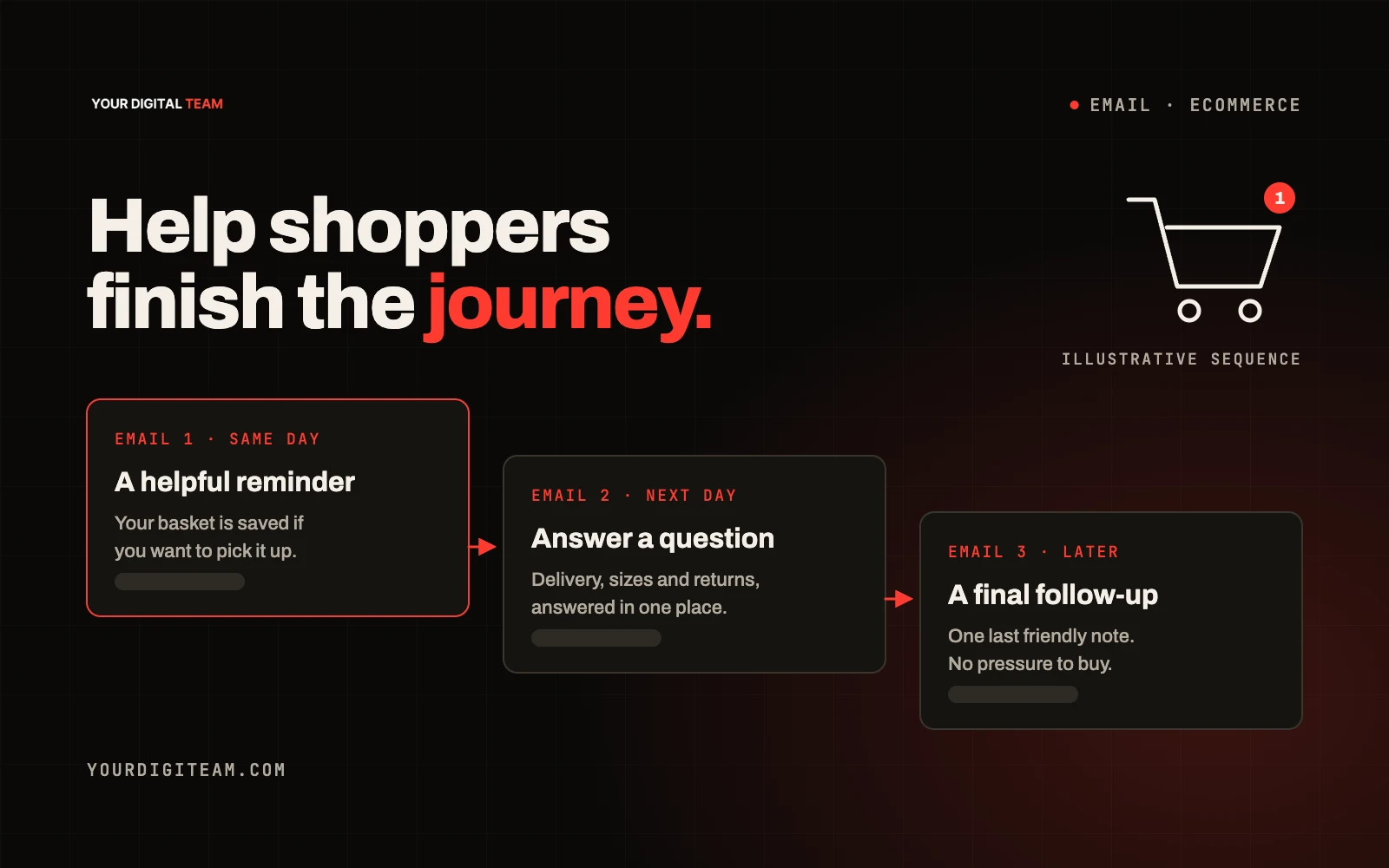
For online shops, this reminds someone they left items in their basket. For service businesses, it is a follow-up after a quote or enquiry that has gone quiet. Our abandoned cart email guide covers timing, content and examples.
3. A regular newsletter
Once your automations are running, add a regular email to keep you in mind between purchases. One main story, one offer or tip and one clear link is plenty.
What to send and how often
The best email marketing tips for small business come down to one rule: send things your customers would be sorry to miss.
Good content ideas include:
- Seasonal reminders ("time to book your boiler service before winter")
- New products, services or availability
- Practical tips related to what you sell
- Customer stories and reviews (with permission)
- Genuine offers, used sparingly
On frequency, consistency matters more than volume. Once a month is a sensible start for most small businesses, fortnightly if you have enough to say. Tell people the frequency when they sign up and stick to it: bursts followed by months of silence lead to unsubscribes and spam complaints.
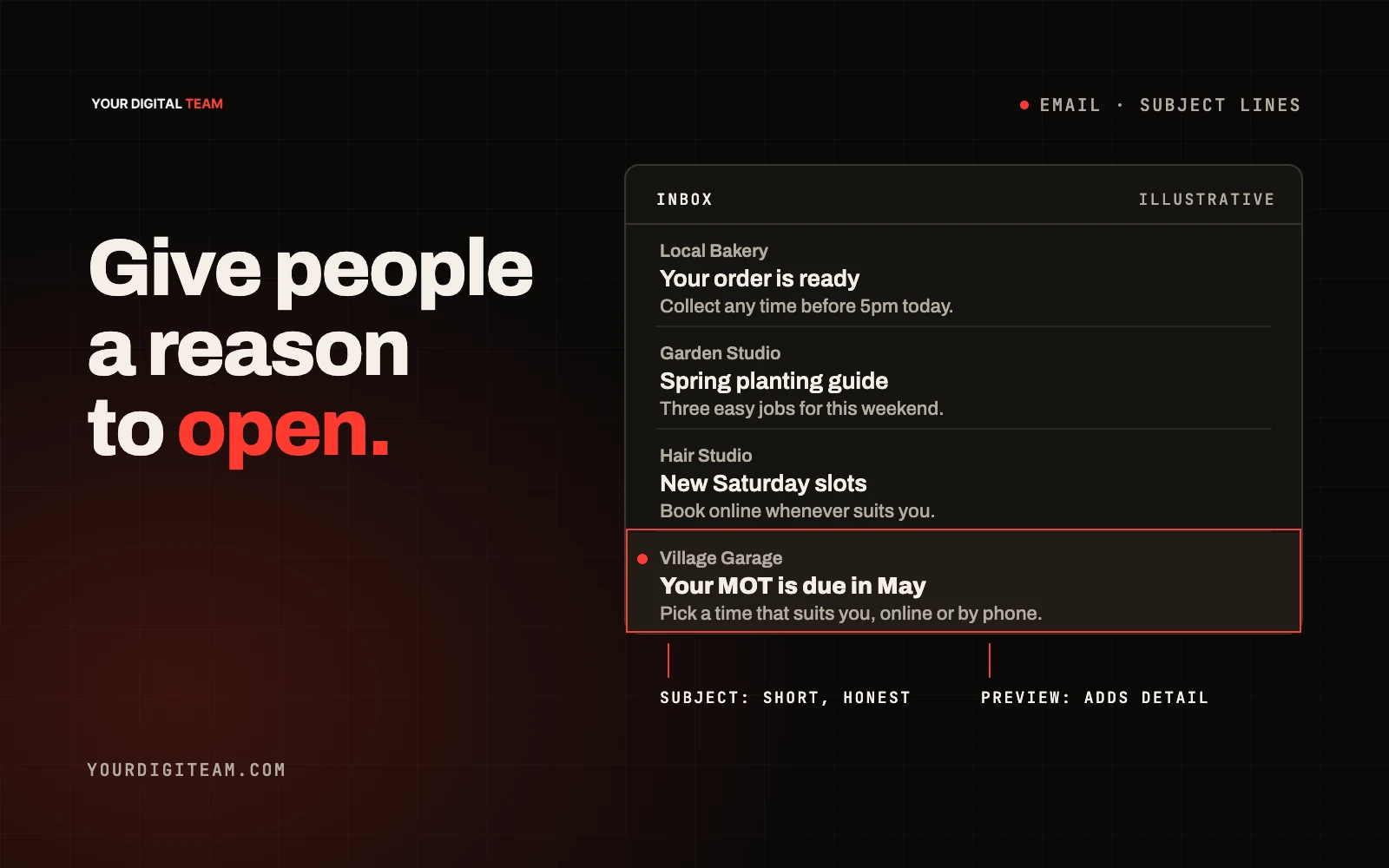
Your subject line decides whether any of this gets read. See our post on email subject lines for small businesses for formulas and examples.
Measuring results
Focus on the numbers that link to money.
| Metric | What it tells you | How much to trust it |
|---|---|---|
| Open rate | Roughly how many opened | Treat with caution (see below) |
| Click rate | How many clicked a link | A better sign of interest |
| Conversions | Sales, bookings or enquiries from email | The number that matters most |
| Unsubscribe rate | Whether content or frequency is off | Watch for sudden rises |
| Spam complaints | Whether people feel they did not sign up | Should be very low |
Open rates are less reliable than they used to be. Apple's Mail Privacy Protection stops senders seeing when an email has been opened, which can inflate or distort open figures. Clicks and conversions are a much better guide.
Make sure your links are tracked in Google Analytics (most platforms add tracking tags automatically). Review monthly, change one thing at a time and compare.
Want email that actually brings people back?
If you would like help setting up your list, automations and first campaigns properly, take a look at our email marketing service. Or get in touch for an honest chat about whether email is the right next step for your business.
Sources
- How do we comply with the PECR electronic mail marketing rules? (ICO)
- Electronic mail marketing, Guide to PECR (ICO)
- Business-to-business marketing (ICO)
- The Data (Use and Access) Act 2025: privacy and electronic communications changes (ICO)
- Consumer Email Tracker 2023 (DMA)
- Email sender guidelines (Google Workspace Admin Help)
- Use Mail Privacy Protection on iPhone (Apple Support)
2026 update: start with one useful email journey
Choose a single reason for somebody to join your list, such as product updates, appointment availability or a useful guide. State what they will receive, then make the first email deliver that promise. A complicated automation is not necessary if the offer and next step are unclear.
For an illustrative independent retailer, the first message could deliver a requested care guide. A later message could explain how to choose the right product, with a link to a relevant category. For a service business, a welcome message might explain how enquiries are handled and which information helps prepare a quote. These are planning examples, not client results.
Before launching, test the signup, welcome message, mobile layout and unsubscribe journey. Keep a record of the audience source and the permissions you rely on. Review replies, useful clicks and completed actions alongside delivery problems. Open rates alone do not tell you whether readers found the message valuable.
Frequently asked questions
What should a small business send first?
Start with a welcome message that delivers what the subscriber requested, explains what to expect and gives one relevant next step.
How many emails should I send?
Choose a frequency you can sustain with useful material and explain it at signup. Watch replies, unsubscribes and completed actions before increasing it.
How do I measure whether emails work?
Track relevant clicks, enquiries, purchases and replies, together with delivery issues and unsubscribes. Use open rates cautiously because they do not reliably show individual reading.
Thomas founded Your Digital Team to help businesses connect SEO, paid media, content and web development to measurable growth.
Meet Your Digital Team