6 min read
Welcome Email Examples for Small Businesses (With Templates)
 Written byThomas FitzgeraldFounder, Your Digital Team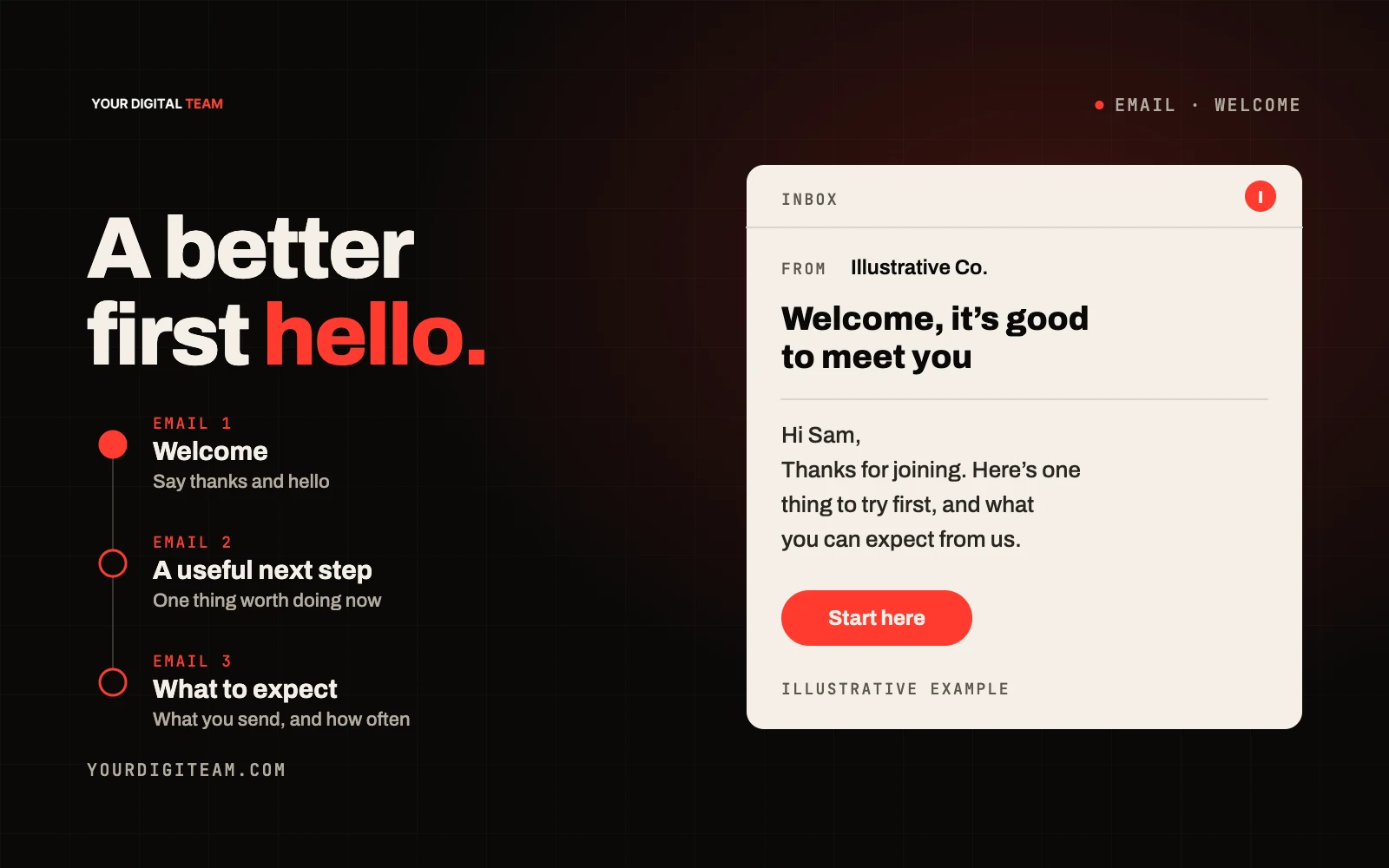
Email marketingPublished 3 Oct 2026
A welcome email is the first message someone receives after joining your mailing list. It should confirm they're in the right place, tell them what to expect, deliver anything you promised when they signed up and give them one useful next step. Because it arrives when interest is highest, it's usually worth more care than any other automated email you send.
Below are original templates for a simple welcome sequence, with suggested timings, plus guidance on permission, setting expectations and measuring whether it's working.
Before you write: permission and expectations
Make sure you're allowed to send
In the UK, marketing emails to individuals are covered by the Privacy and Electronic Communications Regulations (PECR). The ICO explains that you generally need consent to send marketing emails to individuals, with a limited products-and-services exception known as the "soft opt-in" where all conditions are met, including collecting details during a sale or genuine sale negotiations and offering an opt-out at collection and in each message. Its guidance on electronic mail marketing and its detailed compliance guidance are the places to check. Every message must say who it's from and include a working way to unsubscribe. This article isn't legal advice; take advice if you're unsure.
Set expectations at sign-up
The welcome email works best when it confirms what your sign-up form promised. If the form said "a monthly email with tips and offers", don't start sending three emails a week. Write down, in one sentence, what subscribers will get and how often. Use that sentence in the form and the welcome email.
A simple three-email welcome sequence
The timings below are suggestions. Adjust them to your business and audience.
| Suggested timing | Purpose | |
|---|---|---|
| 1. Welcome | Immediately after sign-up | Confirm, deliver, set expectations |
| 2. Useful introduction | 2–4 days later | Show what you know, build trust |
| 3. Gentle next step | 5–8 days later | Invite a relevant action |
Three emails is enough for most small businesses. A longer sequence only makes sense if you have genuinely useful things to say.
Template 1: The welcome email
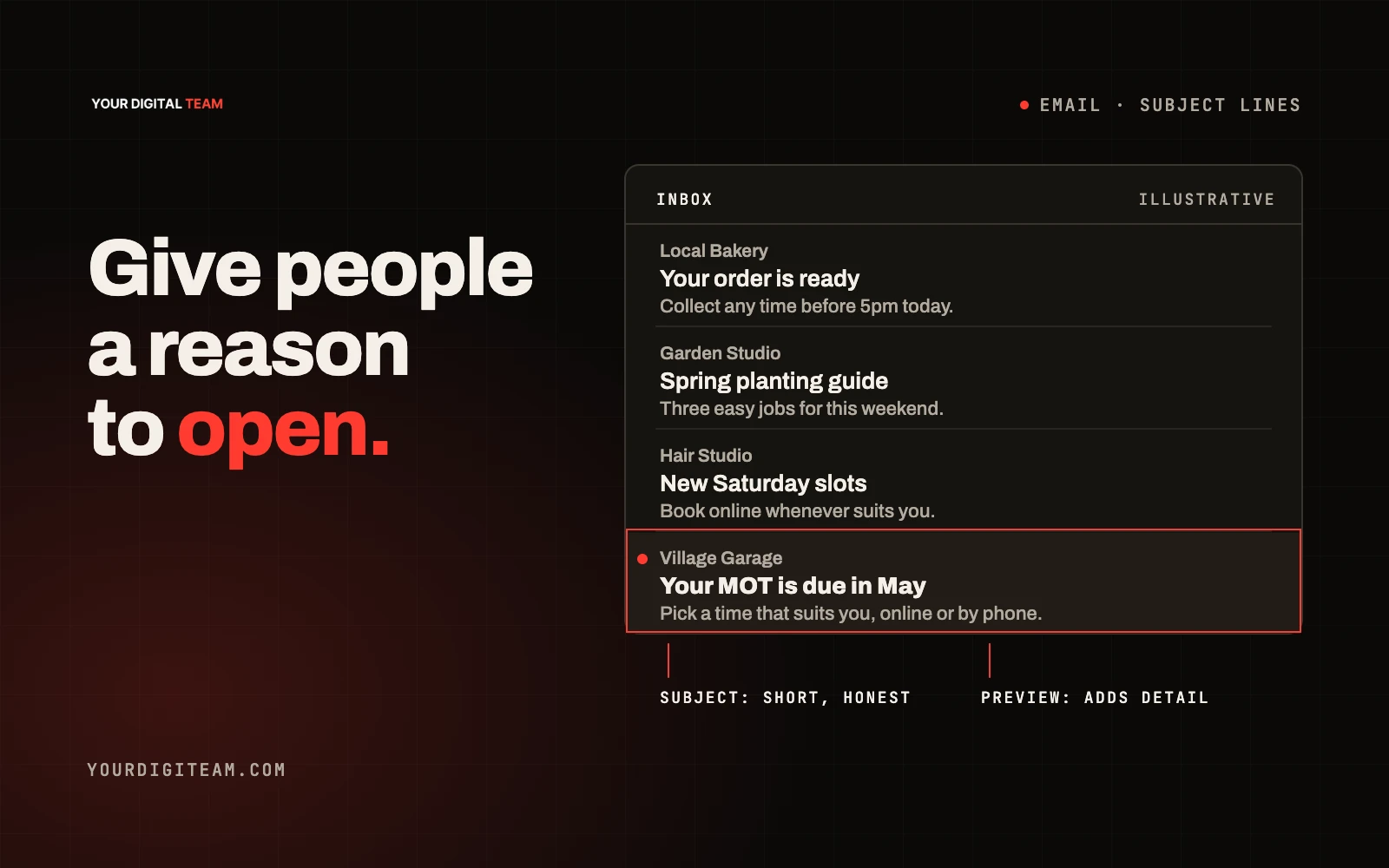
Subject: You're in — here's what to expect Preview text: Plus the [guide/offer] you asked for
Hi [First name],
Thanks for joining the [Business name] mailing list.
Here's what you'll get: [one email a month] with [practical tips on X, news about Y, and occasional offers]. No daily emails, and you can unsubscribe any time using the link at the bottom.
Here's the [guide/discount/checklist] you asked for: [Link or code]
If you'd like to know more about us in the meantime, [our most useful page] is a good place to start: [Link]
Thanks, [Name] [Business name]
[Business address or contact details] · [Unsubscribe link]
Why it works: it confirms the sign-up, delivers the promise straight away and states the frequency so nobody is surprised.
Template 2: The useful introduction
Subject: The question we get asked most Preview text: And the honest answer
Hi [First name],
The question we're asked most often is: [common customer question].
The short answer: [clear, honest answer in two or three sentences].
A few things that make the biggest difference:
- [Practical point 1]
- [Practical point 2]
- [Practical point 3]
We've written more about this here: [Link to a relevant article or page]
If you've got a question of your own, just reply to this email. It comes straight to us.
[Name]
Why it works: it gives value before asking for anything, and the invitation to reply makes the business feel reachable.
Template 3: The gentle next step
Subject: When you're ready Preview text: No pressure — here's how it works
Hi [First name],
If you're thinking about [service/product], here's how it works with us:
- [Step one, e.g. tell us what you need]
- [Step two, e.g. we send a quote or recommendation]
- [Step three, e.g. we agree a date / you place an order]
[Book a call / Get a quote / See the range]: [Link]
And if now isn't the right time, that's fine. You'll hear from us [monthly] with [what they signed up for].
[Name]
Why it works: it invites one clear action without pressure, and it reminds the reader what happens if they don't act.
Variations by business type (illustrative)
These fictional examples show how the first line of the welcome email might change:
- Café or bakery: "Thanks for joining — your free coffee voucher is below, and you'll hear about new bakes once a month."
- Trade or home services: "Thanks for signing up. You'll get seasonal maintenance reminders a few times a year, nothing more."
- Online shop: "Welcome — your discount code is below. We send new arrivals and occasional offers, usually twice a month."
- Professional services: "Thanks for subscribing. Our monthly update covers changes that affect small businesses like yours."
Good practice checklist
- Sender name is recognisable (your business name, or a person plus the business)
- The promised incentive is delivered in the first email
- Frequency is stated clearly
- One main call to action per email
- Unsubscribe link works and is easy to find
- Business contact details included
- Emails read well on a phone
- Links tested before the sequence goes live
If you send in large volumes, Gmail's email sender guidelines set technical requirements such as authentication and easy unsubscribe for bulk senders. Your email platform can help you meet them.
How to measure your welcome sequence
Be careful with open rates
Open rates are less reliable than they used to be. Mailchimp explains that Apple Mail Privacy Protection can preload tracking pixels, so emails may be reported as opened when they weren't. Treat open rates as a rough indicator, not a precise figure.
Better measures
- Clicks on your main link
- Replies, which suggest real engagement
- Unsubscribes after each email, which can flag a message that misses the mark
- Enquiries, bookings or sales from people who went through the sequence
Review the sequence every few months. Update links, refresh the introduction email and cut anything that isn't earning its place.
Frequently asked questions
How soon should the welcome email be sent? Usually straight away, while the person still remembers signing up.
Should the welcome email include a discount? Only if you promised one or it suits your business. A useful guide or clear expectations can be just as effective.
How many emails should a welcome sequence have? Three is a good starting point for most small businesses. Add more only if each has a clear purpose.
Can I send a welcome email to customers I added manually? Only if you have a lawful basis to send them marketing emails. Check the ICO's guidance before importing contacts.
Want help setting it up?
We plan and write welcome sequences as part of our email marketing service. If you're weighing up costs first, see how much email marketing costs for a small business, or read how email fits into content marketing. Ready to talk? Get in touch.