6 min read
Email Subject Lines for Small Businesses: Examples by Purpose
 Written byThomas FitzgeraldFounder, Your Digital Team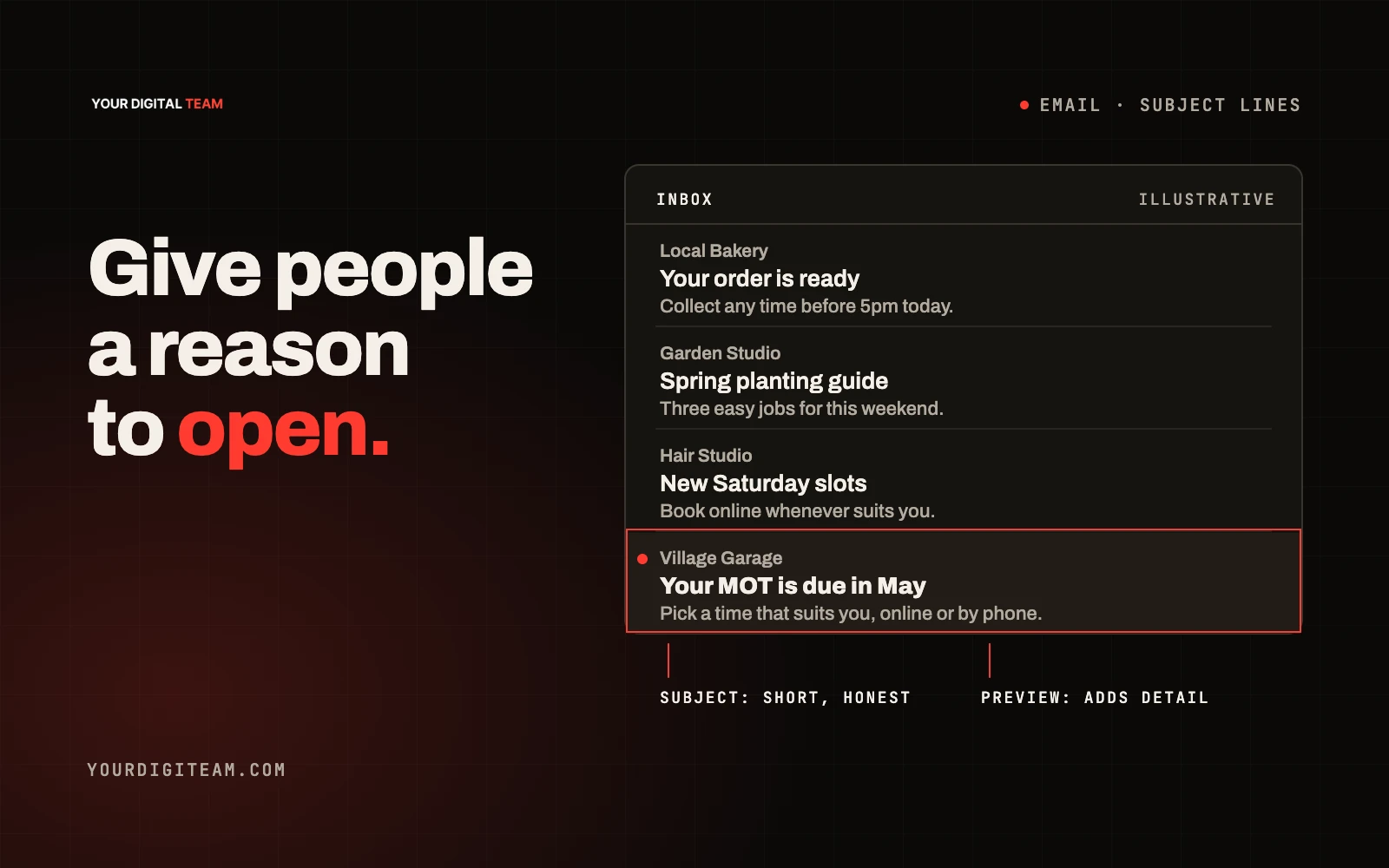
Email marketingPublished 6 Oct 2026
A good email subject line tells the reader what's inside and gives them a reason to open it now. For a small business, that usually means being clear rather than clever: say what the email is about, keep it short enough to read on a phone, and make sure the email delivers what the subject promises. Pair it with preview text that adds to the subject rather than repeating it, and test changes honestly rather than relying on open rates alone.
Below are original examples grouped by purpose, followed by guidance on preview text, what to avoid and how to test.
What makes a subject line work
- Clarity: the reader can tell what's inside
- Relevance: it matters to the person receiving it
- Honesty: the email delivers what the subject promises
- Length: the key words come first, because the end may be cut off on mobile
- Recognisable sender: the "from" name matters as much as the subject
The UK advertising rules in the CAP Code apply to marketing emails, so avoid misleading claims or false urgency. The ICO's guidance also says you must not disguise or conceal your identity in marketing messages, as covered in its PECR compliance guidance.
Examples by purpose
All examples below are original and illustrative. Replace the details with your own.
Newsletters and updates
- Your [Month] update from [Business name]
- 3 things worth knowing this month
- What's new at [Business name] this spring
- The [topic] question we got asked most in [Month]
- [Month] news: new opening hours and a new service
Useful tips and advice
- How to [solve a common problem] in 10 minutes
- The one [maintenance task] most people forget
- Before you book [service], check these 3 things
- A quick guide to [topic] for small businesses
- [Seasonal task] checklist for [season]
Offers and sales
- 15% off [product range] until Sunday
- Free delivery this weekend only
- Your members' price on [product] is live
- [Product] is back in stock
- Last day of our [event] offer
Only state an end date if the offer really ends then.
New products or services
- New: [product or service name]
- We now offer [service] in [area]
- Introducing [product]: [one-line benefit]
- First look at our new [range]
Events and bookings
- Save the date: [event] on [date]
- [Event] places are filling up — [number] left
- Your booking for [date] is confirmed
- Reminder: [event] starts tomorrow at [time]
(Booking confirmations and reminders are usually service messages rather than marketing, but they still benefit from clear subject lines.)
Re-engagement
- Still want to hear from us?
- Should we keep sending these?
- We haven't seen you in a while — here's what's changed
- Update your preferences in one click
Feedback and reviews
- How did we do on your [service]?
- One quick question about your recent order
- Could you spare a minute to tell us what you thought?
Preview text: the second line
Preview text (sometimes called preheader text) appears next to or below the subject in many inboxes. If you don't set it, the email client may show the first line of your email, which is often "View in browser" or an image description.
Rule of thumb: use preview text to add information, not repeat it.
| Subject | Weak preview text | Stronger preview text |
|---|---|---|
| Your [Month] update from [Business] | Your [Month] update from [Business] | New service, new hours and a tip for winter |
| 15% off [range] until Sunday | Don't miss out! | Plus free delivery on orders over £X |
| How did we do on your [service]? | We'd love your feedback | Takes about a minute — just two questions |
What to avoid
- Misleading subjects: "Re:" or "Fwd:" on an email that isn't a reply
- False urgency: countdowns or "last chance" when it isn't
- All capitals and excessive punctuation: they look like spam and read like shouting
- Vague teasers: "You won't believe this" tells the reader nothing
- Overusing the person's name: it can feel automated rather than personal
- Subjects that don't match the email: they erode trust and increase unsubscribes
Technical basics that affect whether you're seen
Your subject line only matters if the email reaches the inbox. If you send in larger volumes, Gmail's email sender guidelines set requirements for bulk senders, including email authentication, keeping spam complaints low and offering easy unsubscribe. Your email platform should help with the setup.
Good list habits help too: only email people who asked to hear from you, remove addresses that bounce, and make unsubscribing easy.
How to test subject lines honestly
Why open rates can mislead
Open rates used to be the standard way to judge subject lines. They're now less reliable. Mailchimp explains that Apple Mail Privacy Protection can preload images and report emails as opened even when they weren't. That makes open-rate comparisons noisier, especially if many of your subscribers use Apple Mail.
A simple, fair testing approach
- Test one thing at a time, for example a question versus a statement.
- Use a meaningful sample. With a small list, differences between versions may just be chance.
- Judge on clicks and outcomes, such as bookings or sales, not only opens.
- Repeat tests before drawing firm conclusions.
- Keep notes on what you tested and what happened.
For small lists, it's often more useful to keep a simple log of subject lines and results over several months than to run formal A/B tests on every send.
A quick checklist before you send
- Subject says clearly what's inside
- Key words appear in the first few words
- Preview text adds new information
- Sender name is recognisable
- Any offer or deadline is accurate
- The email delivers what the subject promises
- Unsubscribe link works
Frequently asked questions
How long should an email subject line be? There's no single right length. Put the important words first so the meaning survives if the end is cut off on mobile.
Should I use emojis in subject lines? They can work for some brands and audiences but not others. If you use them, make sure the subject still makes sense without them, as they may display differently across devices.
Should I personalise subject lines with names? Sometimes. Use it sparingly; relevance usually matters more than including a name.
What's a good open rate? Because privacy features can inflate opens, compare your own results over time and focus on clicks and outcomes rather than chasing an external benchmark.
Want help with your emails?
We write and manage email campaigns as part of our email marketing service. If you're budgeting, see how much email marketing costs, and for the bigger picture, what content marketing actually is. Get in touch for help with your next campaign.
Sources
- Gmail Help — Email sender guidelines
- Mailchimp — Apple Mail Privacy Protection FAQs
- ICO — How do we comply with the PECR electronic mail marketing rules?
- ASA / CAP — The CAP Code (non-broadcast)