7 min read
How to Choose a Domain Name for Your Business
 Written byThomas FitzgeraldFounder, Your Digital Team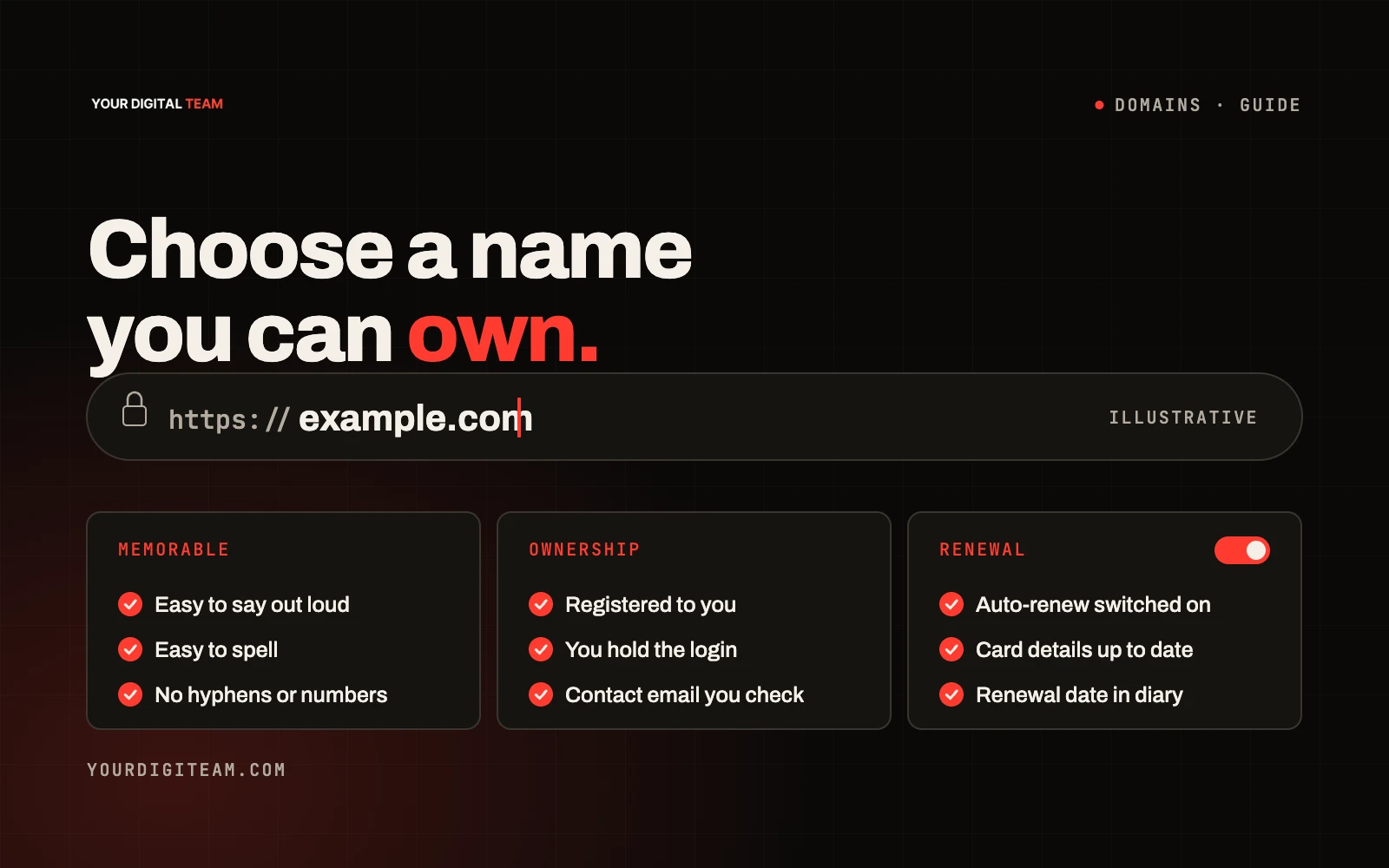
WebsitesPublished 27 Sep 2026
The best domain name for a small business is short, easy to say out loud, easy to spell after hearing it once, and clearly connected to your business name. Before you buy it, you should check it is not tied up in someone else's trade mark, register it in your business's own name, and set it to renew automatically.
That last part matters as much as the name itself. Plenty of businesses pick a good domain and then lose it years later because a renewal notice went to an old email address.
Start with how people will hear it
Most domain names are passed on by word of mouth, on the side of a van, on a business card or read out on the phone. So test your shortlist by saying each option to someone and asking them to type it without seeing it.
Watch for:
- Spelling traps. Words with more than one common spelling, such as "colour" and "color", or names like "Philips" and "Phillips".
- Hyphens. They work in writing but are awkward to say. "Smith hyphen roofing dot co dot uk" is easy to get wrong.
- Numbers. Is it "4" or "four"? Pick one and consider owning both.
- Accidental words. Run the words together and read them as one string. Some combinations spell something you did not intend.
A practical shortlist process
- Write down your exact business name as it appears on invoices and signage.
- Create three to five variations: the full name, a shortened version, and the name plus your main service if the name alone is ambiguous.
- Check availability at a registrar for the extensions you care about.
- Run the checks below on each available option.
- Say each one out loud to two or three people and see which they type correctly.
- Register your first choice and, if budget allows, the obvious variants.
Worked example (fictional)
A fictional kitchen fitter called "Halden & Rowe Kitchens" might shortlist:
| Option | Pros | Cons |
|---|---|---|
| haldenandrowekitchens.co.uk | Matches the full name | Long; "and" vs "&" confusion |
| haldenrowe.co.uk | Short, memorable | Doesn't say what they do |
| haldenrowekitchens.co.uk | Clear and reasonably short | Still quite long |
A sensible choice would be the third option as the main address, with the second registered and redirected to it.
Which extension should you choose?
For a business trading mainly in the UK, .co.uk is familiar and trusted. .uk is shorter and increasingly common. .com is widely recognised internationally. Country domains such as .uk give Google a geographic signal, as explained in its international-site guidance. A .com can also serve UK customers. No extension guarantees a ranking: choose for your audience, memorability and future plans.
A reasonable approach for many small businesses is to register the .co.uk and .uk versions of the same name, choose one as the main address, and redirect the other to it.
Newer extensions such as .design or .london can work, but some customers still assume a web address ends in .com or .co.uk, so test whether people remember it correctly.
Checks before you buy
Trade marks and company names
Search the UK Intellectual Property Office's trade mark search and Companies House for your shortlisted names. A domain that matches someone else's registered trade mark in the same line of business can lead to a dispute you would rather avoid. This is not legal advice; if something looks close, speak to a solicitor or trade mark attorney.
Social media handles
Check whether matching handles are available on the platforms you plan to use. They do not need to match exactly, but consistency helps customers find you.
History of the domain
If a domain has been registered before, it may have been used for something unrelated or spammy. A quick look at archived versions of the site and a search for the domain in quotes can reveal problems.
Pronunciation and spelling
Do the say-it-out-loud test described above. It catches more problems than any tool.
Register it properly
This is where small businesses most often come unstuck.
Put your business in the registrant field
The registrant holds the registration rights under the registry's terms. It should be your business, not your web designer, a former employee or a family member's personal account. If someone else registers it on your behalf, ask them to confirm in writing that your business is the registrant.
Use an email address that will still exist in five years
Renewal reminders and security notices go to the contact email on the registration. Use a monitored business-controlled address rather than one employee's inbox. Keep an independent recovery address that will still work if the domain or its email fails, and protect the registrar account with two-factor authentication.
Turn on auto-renew and keep payment details current
Domains are registered for a fixed term and must be renewed. For .uk domains, Nominet's published process sends reminders around expiry, suspends a domain that has not been renewed some weeks after the expiry date, and cancels it later if it is still not renewed, after which anyone can register it. The exact timetable is set out in Nominet's renewal procedure. A suspended domain can stop your website and email working, so do not rely on the grace period.
For .com and other generic domains, the process is set by ICANN rules and your registrar's policy, and can differ. Check your registrar's terms.
Keep a simple record
Write down where each domain is registered, the renewal date, which account holds it and who has the login. Store it somewhere the business can access even if one person leaves.
Common pitfalls
- The web designer's account. If your domain sits in a supplier's account and the relationship ends badly, getting it back can be slow. Hold it in your own account and give the supplier access if needed.
- Buying ten variants and forgetting them. Every extra domain is another renewal. Only keep variants you will actually redirect.
- Choosing a name you will outgrow. "Durhamplumbingonly.co.uk" becomes awkward if you expand. Your business name usually ages better than a service-plus-town combination.
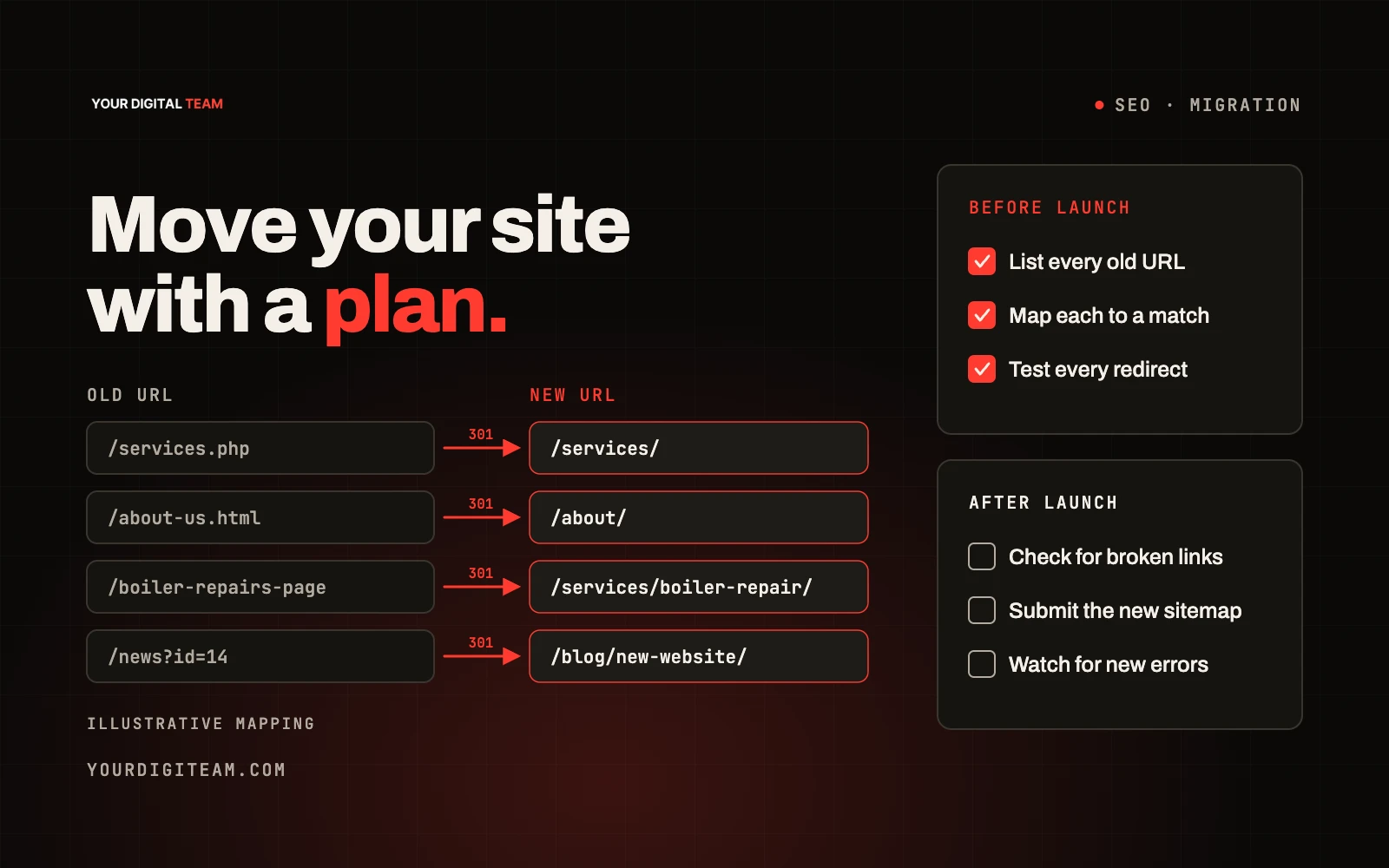
- Changing domains later without a plan. Moving to a new domain once a site is established needs careful redirects. If you are thinking about it, plan it with whoever manages your site.
Frequently asked questions
Does having keywords in my domain help me rank? Not in any way that should drive your choice. Pick a name customers can remember and trust. Your content and reputation matter far more. See our guide to ranking on Google in 2026.
Should I buy both .co.uk and .uk? If budget allows, it is a sensible way to protect your name. Choose one as the main address and redirect the other.
Can I use a domain I bought for email only? Yes. Many businesses use their domain for email before they have a website. It also looks more professional than a free email address.
What if the name I want is taken? Try a variation, such as adding your main service or location, or a different extension. Avoid names that are confusingly close to an existing business in your sector.
Getting the rest right
A good domain is the foundation; a site that loads quickly and explains what you do is what makes it useful. Our article on what makes a high-performance website covers the next step, and why branding matters explains how your name fits into the bigger picture.
If you would like help setting up a domain so your business owns it properly from day one, get in touch or see our web development service.
Sources
- Nominet — Registrar renewals procedure
- GOV.UK — Search for a trade mark
- Companies House — Find and update company information