6 min read
Website Copywriting: How to Write a Homepage and Service Pages That Get Enquiries
 Written byThomas FitzgeraldFounder, Your Digital Team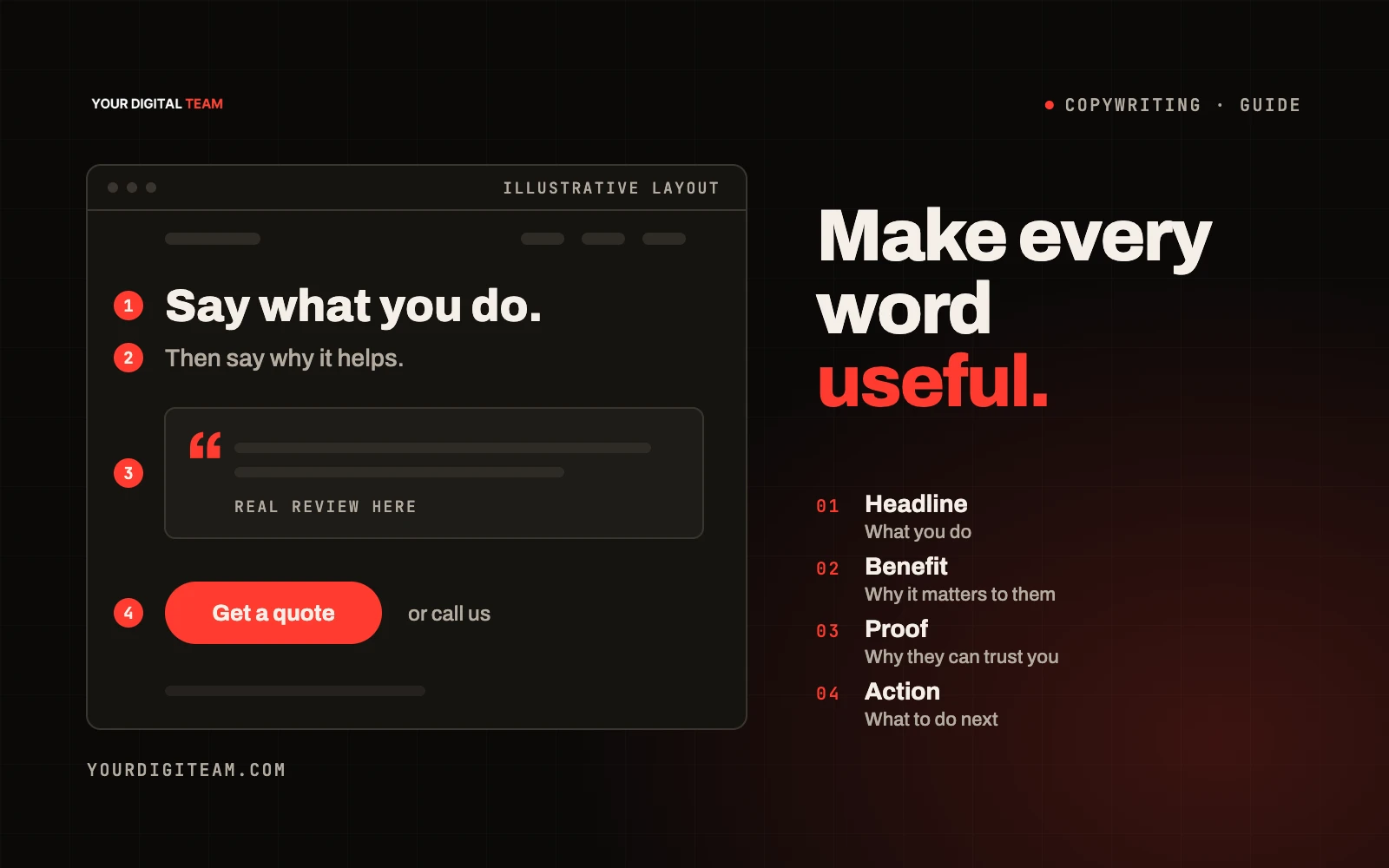
WebsitesPublished 28 Sep 2026
Good website copy tells a visitor, within a few seconds, what you do, who it is for, where you do it and what to do next. It uses the words your customers use, backs up claims with specifics, and removes the doubts that stop people getting in touch. Most small business sites fall short not because the writing is clumsy, but because it talks about the business rather than the customer's problem.
This guide focuses on the writing itself: how to structure a homepage and a service page, how to turn vague sentences into useful ones, and how to check your draft before it goes live.
Start with what visitors actually do
People rarely read web pages word for word. Usability research from the Nielsen Norman Group has long found that users scan pages, picking out headings, the first words of paragraphs and anything that looks relevant to their task. That has practical consequences:
- Put the most important information first, in headings and opening sentences
- Use short paragraphs and descriptive subheadings
- Make links and buttons say what happens when you click them
- Cut anything that does not help someone decide
Google's guidance on helpful, people-first content points the same way: write for the person, answer their question fully, and avoid content made mainly to attract search traffic.
Before you write: gather your raw material
Spend an hour collecting:
- The exact words customers use. Look at enquiry emails, call notes and reviews. If customers say "boiler keeps losing pressure" rather than "heating system diagnostics", use their words.
- The questions you answer on every call. Price guidance, timescales, areas covered, what happens first.
- Your evidence. Accreditations, years trading, insurance, guarantees you actually offer, photos of real work.
- Your boundaries. What you don't do, and where you don't go. Saying so saves everyone time.
How to structure a homepage
A homepage has one job: help each visitor find the right next step. A clear order that works for most service businesses:
- Headline: what you do and for whom.
- Supporting line: where you work and the main reason to choose you.
- Primary action: one clear button, such as "Get a quote" or "Book a call".
- Services: short summaries linking to each service page.
- Proof: reviews, accreditations, examples of work.
- How it works: three or four steps from first contact to finished job.
- Final action: repeat the main call to action.
Before and after: homepage headline
The examples below are illustrative, written for a fictional electrician.
Before: "Welcome to Brightline Electrical — Excellence in Every Connection"
This tells a visitor almost nothing. What do they do? Domestic or commercial? Where?
After: "Electrician for homes and small businesses in Darlington and Teesside — rewires, consumer units and EV chargers"
It is longer, but every word helps someone decide whether they are in the right place.
How to structure a service page
Each service deserves its own page, because each one answers a different question. A reliable outline:
- What the service is in one or two plain sentences
- Who it is for, and signs they need it
- What's included, and what isn't
- How it works, step by step
- Price guidance, even if only a range or "from" figure, and what affects it
- Proof specific to this service
- FAQs drawn from real enquiries
- Call to action
Before and after: service description
Again, illustrative and fictional.
Before: "We provide a comprehensive range of high-quality roofing solutions tailored to your individual needs, delivered by our experienced and professional team."
After: "We repair and replace pitched roofs on houses and small commercial buildings. Most repairs are quoted after a visit and completed within a day. Full replacements include scaffolding, removal of old materials and a written guarantee on workmanship."
The second version is concrete: what, who, how long, what's included. It can be checked, which is what makes it believable.
Rewrite vague claims into specific ones
| Vague | Specific (illustrative) |
|---|---|
| "Competitive prices" | "Fixed quotes before work starts — no day rates" |
| "Fast response" | "We reply to enquiries within one working day" |
| "Fully qualified" | "Gas Safe registered engineers (registration number on request)" |
| "Customer-focused" | "One named contact from quote to completion" |
Only use specifics that are true and that you can keep to. Marketing claims on your own website are covered by the UK advertising codes, which require claims to be accurate and capable of being backed up; the CAP Code is the reference.
Write calls to action that say what happens
"Submit" and "Learn more" are weak because they don't say what comes next. Compare:
- "Get a free quote — we'll reply within one working day"
- "Book a 15-minute call"
- "See prices and availability"
Add a short line near the button that reduces risk: "No obligation", "We don't share your details", or "Most quotes sent the same week", as long as it is true.
Tone: plain, confident, human
The GOV.UK guidance on writing for the web is a useful reference even for businesses. Its advice applies widely:
- Use short, common words
- Write in the active voice ("we fit" rather than "fitting is carried out")
- Address the reader as "you"
- Avoid jargon unless your customers use it
Plain doesn't mean dull. It means the reader never has to work out what you mean.
Check your draft
Before publishing, run through this list:
- Could a stranger say what you do after reading only the headline?
- Is the area you cover stated clearly?
- Does every service have its own page?
- Is every claim specific and true?
- Is there one obvious next step on each page?
- Have you read it aloud to catch awkward sentences?
- Has someone outside the business read it and explained it back to you?
If your site already gets visitors but few enquiries, the copy may be only part of the problem. Our guide to why a website gets traffic but no enquiries covers the wider diagnosis, and why website design wins or loses business covers the design side.
Frequently asked questions
How long should a service page be? Long enough to answer the questions a customer has before contacting you. For most services that is a few hundred words, plus FAQs. Length for its own sake doesn't help.
Should I write my own website copy? You know your customers best, so your input is essential. Many businesses write a rough draft and have it edited. A draft in your own words is far more useful to a copywriter than a blank page.
Do I need to include prices? Not always exact prices, but some price guidance reduces time-wasting enquiries and builds trust. A "from" figure or a list of what affects the price works well.
How do keywords fit in? Use the words your customers use naturally in headings and copy. If you describe the service clearly, you will usually cover the relevant terms without forcing them.
Need help with the words?
We write and edit website copy as part of our content service, and it pairs well with a wider content marketing approach. If you want a page reviewed or rewritten, get in touch.
Sources
- Nielsen Norman Group — How users read on the web
- Google Search Central — Creating helpful, reliable, people-first content
- GOV.UK — Writing for GOV.UK
- ASA / CAP — The CAP Code (non-broadcast)