8 min read
How to increase website traffic: a prioritised list for UK small businesses
 Written byThomas FitzgeraldFounder, Your Digital Team

SearchPublished Updated
If you are wondering how to increase website traffic, the honest answer is to fix things in the right order. Make sure Google can actually find your pages, get your Google Business Profile in shape, then build pages around what people really type into search. Social posts and ads come later, and they work far better once the basics are sorted.
If you would like support with these checks, our SEO agency in Newcastle service explains how we approach the work.
Below is the order we work through with small businesses in the North East and across the UK. Each step has a rough effort level and a realistic timescale, so you can see what is quick, what is slow, and what is free.
First, a reality check: traffic is not the goal
More visitors only matter if some of them ring, book or buy. We regularly see sites that doubled their traffic and got no extra enquiries, because the new visitors were the wrong people or the pages gave them no reason to get in touch. If that sounds familiar, read our guide on why website traffic does not always turn into enquiries before you chase more visitors.
Keep one question in mind for every step below: will this bring in people who could become customers?
The list at a glance
| Step | Effort | Cost | Realistic timescale (illustrative) |
|---|---|---|---|
| 1. Fix technical basics and indexing | Low to medium | Free | Days to a few weeks |
| 2. Google Business Profile | Low | Free | Weeks |
| 3. Target real search terms | Medium | Free to low | 2 to 6 months |
| 4. Useful content | High | Your time | 3 to 12 months |
| 5. Internal linking | Low | Free | Weeks |
| 6. Reviews and local citations | Low, ongoing | Free | Builds over months |
| 7. Email | Medium | Low | Immediate once you have a list |
| 8. Social media | Medium, ongoing | Free to low | Steady, rarely big |
| 9. Paid ads as an accelerator | Low to start | Paid | Same day |
| 10. Digital PR | High | Time or paid | Months, compounds |
1. Fix the technical basics and make sure you are indexed
You cannot get search traffic from pages Google has not indexed. Google's own starter guide suggests a simple check: search "site:yourdomain.co.uk" and, as it puts it, "If you see results pointing to your site, you're in the index."
If key pages are missing, use the URL Inspection tool in Google Search Console. Google says you can request that an inspected URL be indexed, but also that a request "does not guarantee that the page will appear in the Google Index." So treat it as a nudge, not a fix. A sitemap helps Google find all the URLs you care about, especially on larger sites.
While you are there, check the obvious: the site loads quickly on a phone, every page has a clear title, and nothing important is blocked or broken.
Effort: low to medium. Timescale: days to a few weeks, depending on what you find.
2. Get your Google Business Profile right
For most local businesses this is the cheapest win available. Google says local results are based mainly on relevance, distance and prominence, and that "Businesses with complete and accurate info are more likely to show up in local search results."
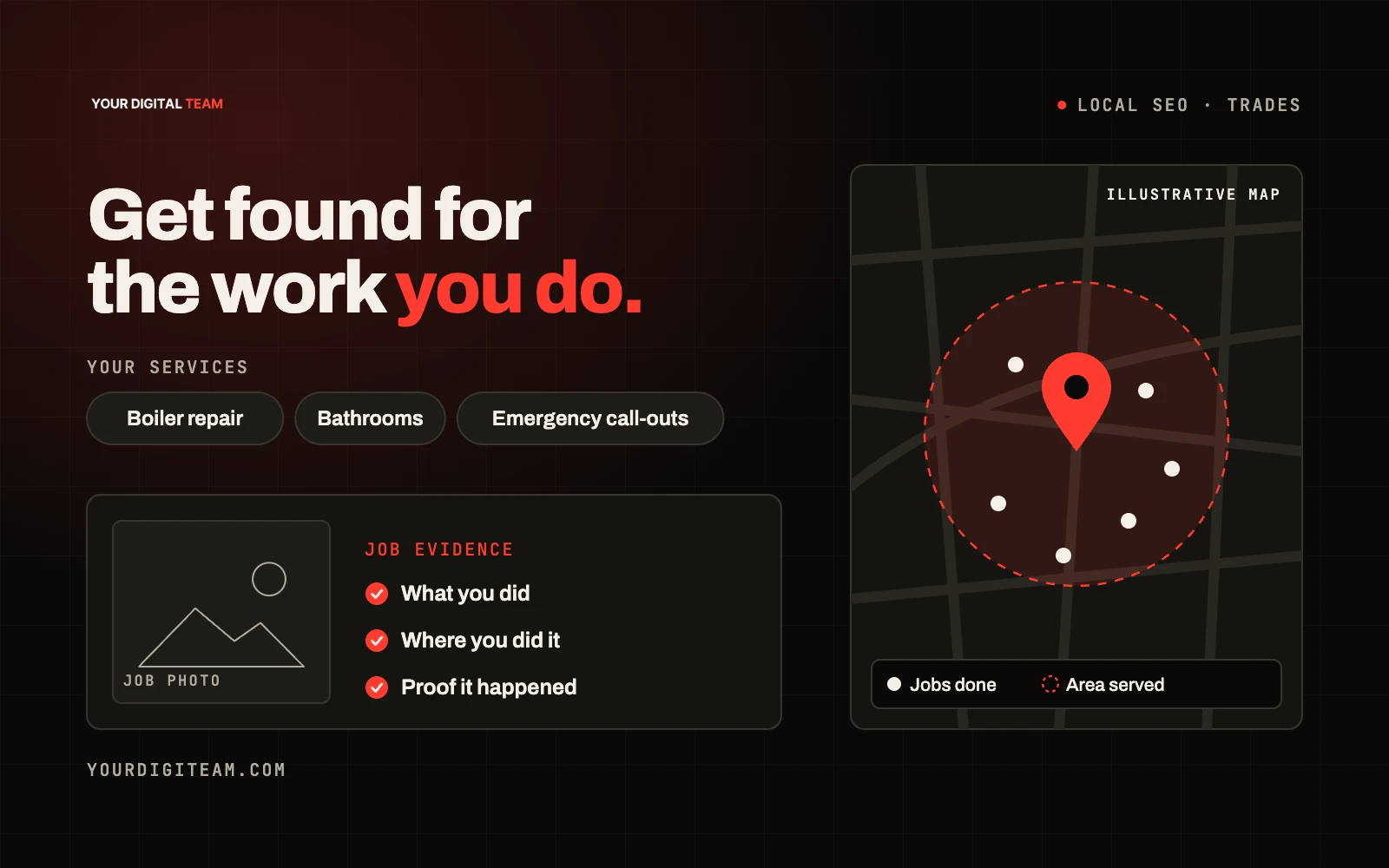
Fill in every field: categories, services, hours, service area, photos and a proper description. Our step-by-step local SEO checklist covers the profile and everything around it. One thing to know up front: Google states there is no way to request or pay for a better local ranking.
Effort: low. Timescale: a few weeks for changes to settle.
3. Target the terms people actually search for
Plenty of small business sites describe themselves in their own words, not their customers' words. A roofer's site that says "bespoke roofing solutions" will struggle against one with a page titled "Flat roof repairs in Durham".
Look at what people search, how many search it, and how hard it is to rank. Then give each important service and location its own page. Our post on keywords that keep climbing explains how to pick terms with lasting value, and our guide to ranking on Google in 2026 covers the wider picture.
Effort: medium. Timescale: usually two to six months to see movement.
4. Publish genuinely useful content
Google's guidance is plain: write content "that your readers will find helpful and reliable." For a small business, that means answering the questions customers ask you on the phone. How much does it cost? How long does it take? What should I check before I hire someone?
One honest, detailed page that answers a real question will do more than ten thin posts written to hit a word count.
Effort: high. Timescale: three to twelve months, but good pages keep bringing visitors for years.
5. Link your own pages together
Internal links are the most overlooked free way to increase website traffic. Google says it uses links "to find new pages to crawl" and as a signal of relevance, and that descriptive anchor text makes it "easier for Google to understand what the page you're linking to is about."
In practice: link from your blog posts to the service pages they relate to, link between related services, and use words like "boiler servicing in Gateshead" rather than "read more".
Effort: low. Timescale: weeks.
6. Build reviews and local citations
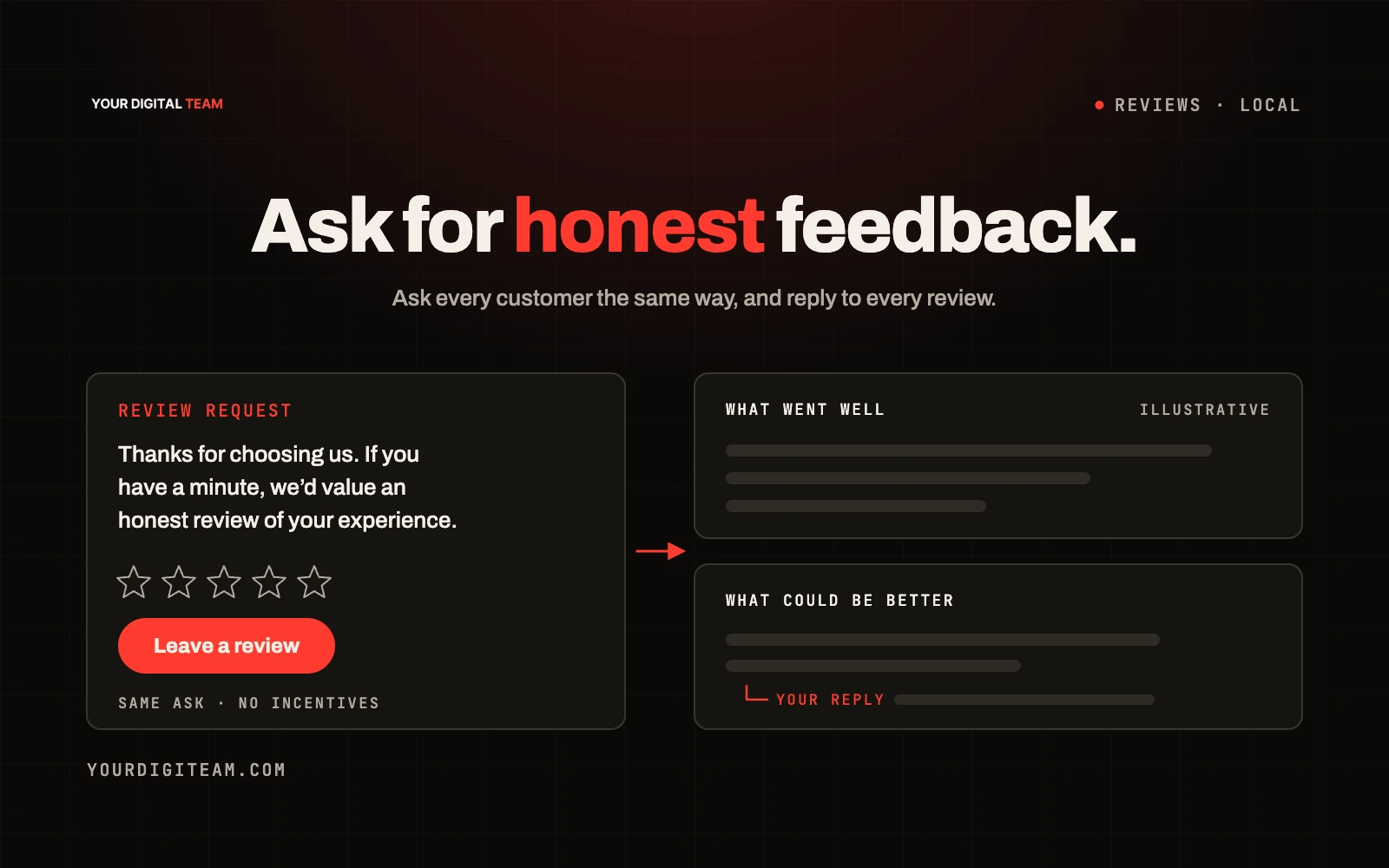
Reviews help you rank and they help people choose you once you do. Google lists review count and links from other websites as part of prominence, and says "More reviews and positive ratings can help your business's local ranking."
They matter to customers too. BrightLocal's 2026 survey of US consumers found 97% read reviews, 74% only look at reviews from the last three months, and 47% will not use a business with fewer than 20 reviews. The panel is American, but the pattern holds for local services here. Ask every happy customer, and reply to every review.
Citations are listings of your name, address and phone number on directories and trade sites. Keep them consistent everywhere.
Effort: low, but ongoing. Timescale: builds steadily over months.
7. Use email to bring people back
Email does not find you new visitors, but it is the most reliable way to bring existing ones back. A short monthly email linking to a new guide, an offer or a seasonal reminder will send traffic the day it goes out.
Start by collecting addresses properly, with consent, from enquiries and customers.
Effort: medium. Timescale: immediate once you have a list.
8. Treat social media as support, not the main engine
Social platforms want people to stay on the platform, so most posts send very little traffic to websites. That does not make social pointless. It builds familiarity, so when someone does search for you, they recognise the name and click.
Share your useful content, show real work, and put your website link where people expect to find it.
Effort: medium and ongoing. Timescale: steady, rarely dramatic.
9. Use paid ads as an accelerator
Google Ads or social ads can send visitors the day you switch them on. That makes them useful for testing which services people want, filling a quiet month, or covering the gap while your search rankings build.
The catch is that traffic stops the moment you stop paying. Ads also expose weak pages fast: if your landing page does not convert, you pay for every visitor who leaves. Get the page right first, then spend.
Effort: low to start, ongoing to manage well. Timescale: same day.
10. Earn links and coverage with digital PR
Links from respected local news sites, trade bodies and industry blogs are one of the strongest signals you can earn, and they bring their own referral traffic.
It is the slowest step here and the hardest to do well, which is why it sits last. Our guide on what digital PR is explains how it works for small businesses.
Effort: high. Timescale: months, but the results compound.
Then make the traffic count
Once visitors start arriving, the job changes. Look at which pages bring enquiries and which do not, then improve the weak ones with clearer calls to action, prices, proof and fewer steps to get in touch. Our guide to improving your website conversion rate walks through how.
A site with 500 visitors a month that converts well will often beat a site with 2,000 that does not (illustrative figures).
Want more of the right visitors?
If you would like a straight answer on what is holding your traffic back, we can look at your site and tell you which of these steps matters most for you. See how our SEO service works, or get in touch for a no-pressure chat.
Sources
- How to improve your local ranking on Google, Google Business Profile Help
- SEO Starter Guide, Google Search Central
- Link best practices for Google, Google Search Central
- URL Inspection tool, Search Console Help
- Local Consumer Review Survey 2026, BrightLocal
2026 update: improve pages that already have demand
Export your search queries and landing pages for a consistent period. Look for pages receiving impressions for relevant questions but few clicks. Check whether the title describes the answer clearly, whether the page delivers it promptly and whether another page on your own site serves the same intent.
Choose one meaningful improvement per page before publishing more content. That could be a worked example, a clearer comparison, current scope information or a link from a related guide. Keep the page's main purpose stable so you can interpret the next comparison.
Distribution matters too. Link a useful guide from the service it explains, include it in a relevant email and reuse an excerpt in a social post with an accurate destination. Measure relevant visits and the next action rather than treating every traffic increase as a success. Document changes and compare equivalent periods, allowing for seasonality and any campaign activity.
Frequently asked questions
Should I publish new pages or improve existing ones?
Start with relevant existing pages that already receive impressions or answer important customer questions. Create a new page when it serves a distinct need that existing content does not cover.
Can internal links increase website traffic?
Useful internal links help visitors and crawlers find related pages. They support discovery and navigation, but do not guarantee rankings or a particular traffic increase.
How should I measure progress?
Compare equivalent periods and review relevant search queries, landing pages and completed actions. Record content and tracking changes so you can explain differences.
Thomas founded Your Digital Team to help businesses connect SEO, paid media, content and web development to measurable growth.
Meet Your Digital Team