8 min read
The local SEO checklist for UK small businesses
 Written byThomas FitzgeraldFounder, Your Digital Team

SearchPublished
This local SEO checklist covers the jobs that matter most for UK small businesses trying to show up in Google Maps and local search: your Google Business Profile, consistent contact details, citations, reviews, local landing pages, on-page basics, links and tracking. Work through it top to bottom, tick off what you have done, and the gaps will be obvious.
For the background on why these things matter, our guide to what affects local SEO rankings explains the ranking factors in depth. This page is the to-do list.
How Google decides who shows up locally
Google says local results are based mainly on three things: relevance (how well your profile matches the search), distance (how far you are from the searcher, or the location in the search) and prominence (how well known your business is, which includes reviews, ratings and how many websites link to you). Google also says there is no way to pay for a better local ranking.
You cannot change distance. Almost everything below is about improving relevance and prominence, so Google has more reasons to show you.
1. Google Business Profile
Your profile is the biggest lever for Google Maps ranking. If you have not set one up yet, start with our step-by-step guide on how to set up a Google Business Profile, then come back to this list.
- Profile claimed and verified
- Business name matches your real-world name, with no added keywords, towns or taglines
- Primary category is the most specific one that describes what you are (for example "Roofing contractor", not "Contractor")
- As few secondary categories as genuinely apply
- Address is exact, or hidden with a service area set if you visit customers rather than have them visit you
- Phone number is local and rings at this business, not a shared call centre
- Opening hours set, plus special hours for bank holidays and Christmas
- Services or products listed, with short plain descriptions
- Business description written for customers, explaining what you do and where
- Real photos of your work, team, vehicles or premises added, and topped up regularly
Resist renaming yourself "Plumber Durham Cheap Emergency". Google's guidelines say unnecessary information in the name is not permitted, and breaking the guidelines puts your profile at risk. For the ongoing side of profile work, see our guide to using Google Business Profile for local SEO.
2. NAP consistency
NAP stands for name, address and phone number. Pick one exact version and use it everywhere, because mismatches confuse customers and search engines alike.
- One agreed format for your name, address and phone (write it down and share it with anyone who updates your listings)
- Website footer and contact page use that exact format
- Old addresses and old phone numbers updated or removed wherever you can find them
- Trading name used consistently (not "Smith Plumbing" in one place and "J Smith & Sons Ltd" in another, unless both are genuinely needed)
3. Local citations
Local citations are mentions of your name, address and phone number on other sites, usually directories. They help Google confirm you are a real business in a real place.
- Core platforms: Apple Business Connect (for Apple Maps), Bing Places, Facebook
- Main UK directories relevant to you, for example Yell, Thomson Local, Scoot or FreeIndex
- Trade and industry bodies you belong to (Gas Safe, NICEIC, Checkatrade, TrustMark, The Law Society and so on)
- Local sources: chamber of commerce, council business directories, local news business listings
- Every listing checked against your agreed NAP format
Skip packages promising hundreds of directory submissions. A few dozen accurate, relevant listings beat a pile of sites nobody visits.
4. Reviews
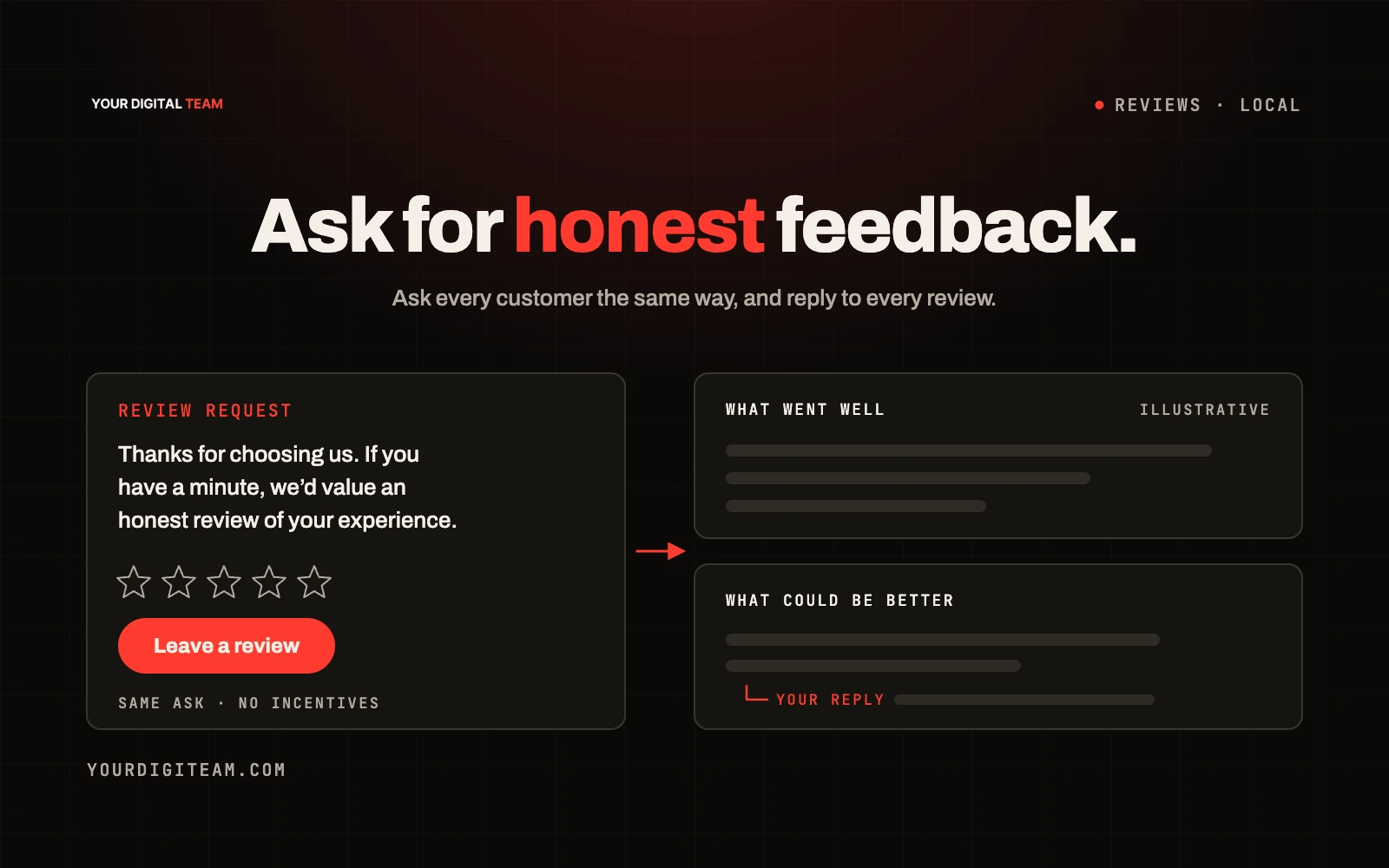
Reviews feed directly into prominence and often decide who gets the call. Our full guide on how to get more Google reviews has scripts and timings, but here is the checklist version.
- Short review link or QR code created from your Business Profile
- A simple routine for asking every customer, ideally soon after the job or purchase
- Every review replied to promptly, politely and personally
- Negative reviews answered calmly, without sharing private details or arguing
- No incentives offered for reviews, and no asking only happy customers
Google prohibits offering discounts or freebies in exchange for reviews. In the UK, the Digital Markets, Competition and Consumers Act made fake reviews, undisclosed incentivised reviews and misleading presentation of reviews (such as hiding negative ones) unlawful from 6 April 2025, with potential fines of up to 10% of global turnover. Ask everyone, honestly, and you will be on the right side of both.
5. Local landing pages
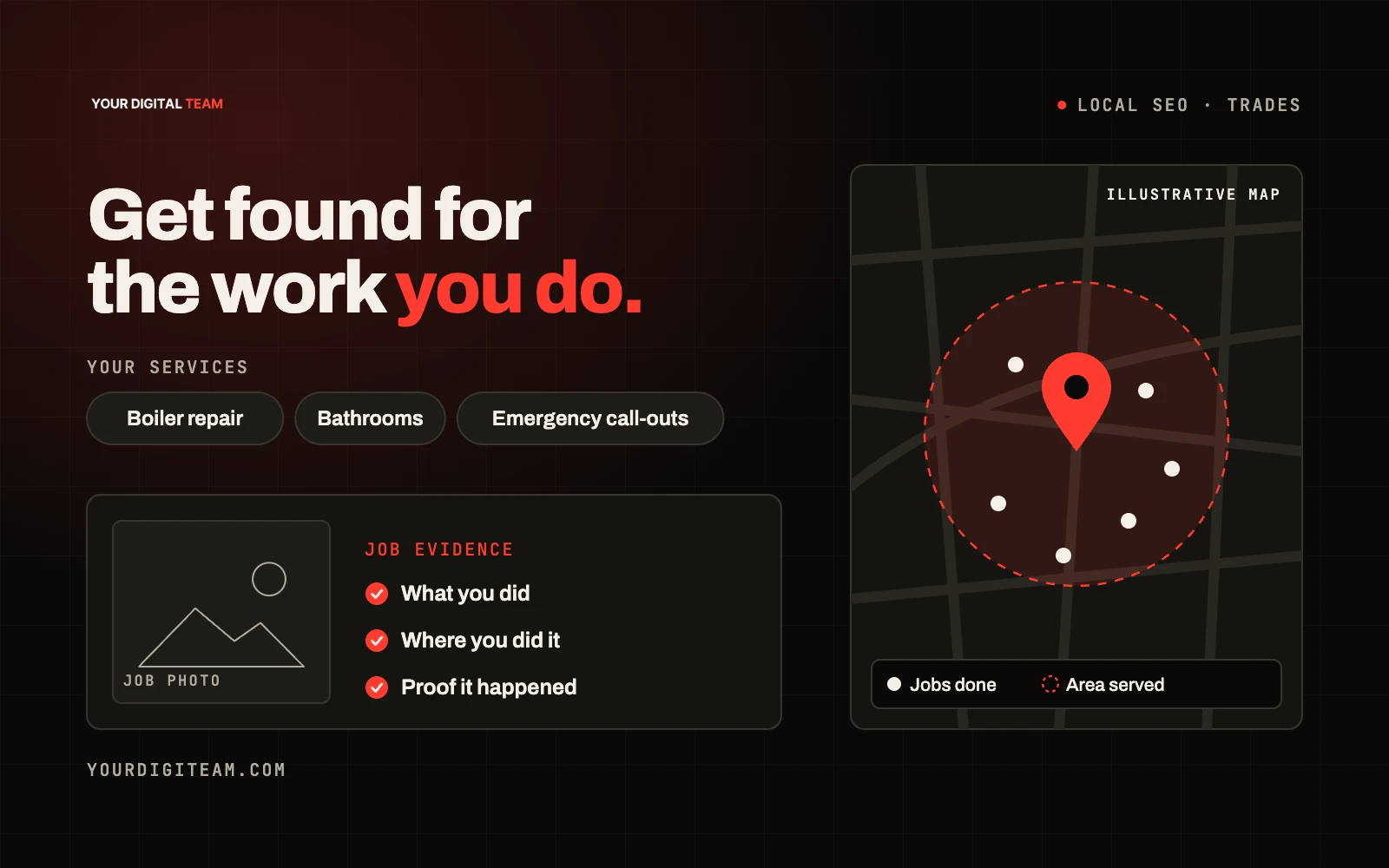
If you serve several towns, or offer several distinct services, your website needs pages that match what people search for. One generic "Services" page rarely ranks for "boiler repair Sunderland".
- One page per core service
- One page per main town or area you genuinely serve, if you serve more than one
- Each page has unique content: local jobs you have done, areas covered, local photos, relevant reviews, travel or parking information
- No copy-and-paste pages with only the town name swapped
- Clear call to action and phone number on every page
Quick test: if you could swap the town name and nothing else would need to change, the page is too thin.
6. On-page basics
- Title tags include the service and location, for example "Emergency Plumber in Gateshead | Business Name"
- Meta descriptions written for people, with the service and area mentioned
- One clear H1 per page that says what the page is about
- Town or area mentioned naturally in the copy, not stuffed
- LocalBusiness structured data (schema) on your site with your name, address, phone, opening hours and URL
- Site loads quickly and works properly on a phone
- Click-to-call phone number on mobile
- Pages indexed in Google Search Console
7. Local links and mentions
Links from other websites count towards prominence. For local businesses, the best ones come from real relationships.
- Suppliers and manufacturers you use (many have "find an installer" or stockist pages)
- Local sponsorships: sports clubs, school events, charity fundraisers
- Local press: a new hire, a community project, an award or a milestone
- Business partners who refer work to you, and you to them
- Local business groups, networking clubs and chambers of commerce
Avoid buying links. Five genuine local links are worth more than fifty bought ones.
8. Tracking and reporting
You do not need a complicated dashboard, just a few numbers checked monthly.
- Business Profile performance checked monthly: searches, calls, website clicks, direction requests
- UTM tag on your Business Profile website link, so profile visits show separately in Google Analytics
- Google Search Console set up and checked for local search terms and clicks
- Enquiries tracked by source (calls, forms, emails), even if it is just a spreadsheet
- A small set of local search terms checked on a phone in your area every month or two
Look for trends over three to six months, not weekly wobbles.
How to work through this checklist
Short on time? Tackle it in this order. The first three can usually be done in a few focused afternoons; the rest is ongoing.
| Priority | Area | Typical effort (illustrative) |
|---|---|---|
| 1 | Google Business Profile | 2 to 4 hours, then 30 minutes a month |
| 2 | NAP and core citations | Half a day to a day |
| 3 | Reviews routine | 1 hour to set up, then part of every job |
| 4 | Local landing pages | A few hours per page |
| 5 | On-page basics | Half a day to a day, depending on the site |
| 6 | Local links | Ongoing, a few hours a month |
| 7 | Tracking | 1 to 2 hours to set up, 30 minutes a month |
Once the foundations are done, the businesses that pull ahead are the ones that keep going. If you want more visitors beyond Maps too, our guide on how to increase website traffic picks up from here.
Frequently asked questions
How long does local SEO take to work?
Fixing your Google Business Profile and contact details can lead to changes in a few weeks, especially if the profile was incomplete. Building reviews, local pages and links takes longer, usually several months, and results depend on how competitive your area and trade are.
Can I do local SEO myself?
Yes. Most of this checklist can be done by a business owner with a few hours a month. People more often get stuck on the website side, such as structured data, page speed and local pages that rank, which is where outside help saves time.
What are local citations and do they still matter?
Local citations are listings of your business name, address and phone number on other websites, such as directories, trade bodies and maps apps. Accurate citations on the main platforms help confirm where you are based, but chasing hundreds of low-quality directories does not.
How do I improve my Google Maps ranking?
Google says local rankings depend on relevance, distance and prominence. Complete and verify your Business Profile, choose the most accurate category, keep your details consistent, collect genuine reviews and earn links from local websites. You cannot pay Google for a better local position.
How much does local SEO cost in the UK?
It depends on whether you do it yourself or hire help, how many locations you have and how competitive your market is. Our guide to local SEO costs in the UK breaks down typical pricing models and what you should expect for the money.
Want someone to run the checklist for you?
If you would rather spend your time running the business, we can audit your profile, citations and website against this list and tell you honestly what needs doing first. Have a look at our SEO services or get in touch for a no-pressure chat.
Sources
- How to improve your local ranking on Google, Google Business Profile Help
- Guidelines for representing your business on Google, Google Business Profile Help
- Tips to get more Google reviews, Google Business Profile Help
- Understand your Business Profile performance and insights, Google Business Profile Help
- Local business structured data, Google Search Central
- No more faux five-stars: The DMCC Act bans fake reviews, CMS
Thomas founded Your Digital Team to help businesses connect SEO, paid media, content and web development to measurable growth.
Meet Your Digital Team