4 min read
What Affects Local SEO Rankings?
 Written byThomas FitzgeraldFounder, Your Digital Team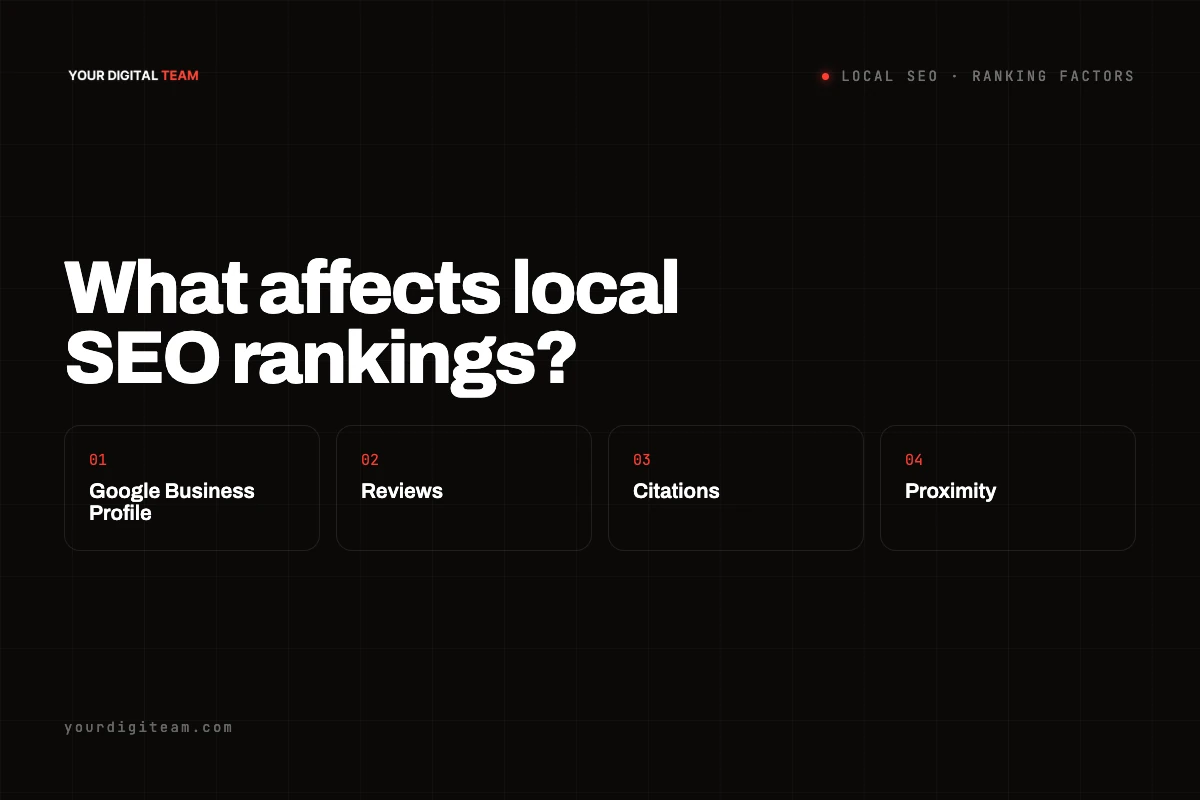
SearchPublished 17 Sep 2026
The signals Google uses to decide who ranks in the map pack — and what to fix first if you're not showing up.
Two businesses on the same street, doing the same thing, with the same website. One shows up in the map pack for every relevant search. The other doesn't appear at all.
The difference is rarely luck. Google uses a specific set of signals to decide who ranks locally — and most of them can be influenced. Here's what actually moves the needle.
01 — The three core factors
What Google says it looks at.
Google has publicly stated that local rankings are based on three things:
- Relevance. How well your business matches what was searched. Your categories, your services, your description.
- Distance. How close you are to the searcher, or to the location they typed. You can't change this — but you can make sure Google knows exactly where you are.
- Prominence. How well-known and trusted your business is. Reviews, links, mentions, and how established your online presence looks.
Everything else is a tactic to improve one of those three.
02 — Google Business Profile
The single biggest lever.
Your Google Business Profile is what appears in the map pack. It's free, and most businesses have one — but most have never optimised it. The things that matter:
- Primary category. The single most important field. "Plumber" not "Contractor." Be specific.
- Complete information. Hours, phone, website, address, services, attributes. Every empty field is a missed signal.
- Photos. Businesses with 100+ photos get more clicks and calls. Real photos of your work, your van, your team.
- Posts. Regular updates signal an active business. Weekly is ideal.
- Q&A. Answer common questions before customers ask them.
03 — Reviews
Quantity, quality, recency, and responses.
Reviews are the most visible prominence signal. Google looks at how many you have, what your average rating is, how recently you got them, and whether you respond.
A business with 150 reviews averaging 4.8 with a new one every week will outrank one with 12 reviews from 2022. Build a system for asking — after every job, every time.
A steady stream of genuine reviews does more for local rankings than any technical trick. It's the one thing your competitors can't copy overnight.
04 — Your website
On-page local signals.
- Location pages. If you serve multiple areas, each needs its own page — not a list of towns in the footer.
- NAP consistency. Name, address, phone — identical everywhere. On your site, your GBP, every directory.
- Local schema markup. Structured data that tells Google exactly what and where you are.
- Mobile performance. Local searches are overwhelmingly mobile. A slow site loses the click. See our mobile guide.
- Embedded map. Reinforces location to Google.
05 — Citations and links
Being mentioned elsewhere.
Citations are mentions of your business name, address, and phone on other sites — directories like Yell, Checkatrade, Thomson Local, and industry-specific listings. Consistency matters more than volume.
Local links from other businesses, local news, sponsorships, and community organisations tell Google you're a real part of the local area. They're harder to get than citations and worth more.
06 — What doesn't work
Tactics that hurt more than help.
- Keyword stuffing your business name ("Bob's Plumbing Best Plumber Newcastle")
- Fake reviews — Google is getting better at detecting them, and the penalty is severe
- Fake locations or virtual offices
- Buying links or citations from low-quality sources
07 — Where to start
Priority order.
Google Business Profile first — complete and optimised. Then a review system. Then fix your NAP consistency. Then location pages on your site. Then citations. Then links. That order gets the biggest wins fastest.
Or let us do it. Our local SEO service covers all of it, with a live dashboard showing your map pack position for every keyword that matters.
Wondering what it costs? Read: How much does local SEO cost — and is it worth it?