4 min read
Why Your Website Is Either Winning or Losing Business Right Now
 Written byThomas FitzgeraldFounder, Your Digital Team
WebsitesPublished 26 Aug 2026
Most businesses underestimate what their website is actually doing — or failing to do. Here's why great design isn't aesthetic, it's commercial.
Your website isn't a brochure. It's a salesperson that works 24 hours a day, never takes a day off, and is talking to your best potential customers right now — while you're reading this.
The question isn't whether you have a website. It's whether the one you have is winning business or quietly losing it.
First impressions happen in 50 milliseconds. Research from Google puts it plainly: users form an opinion about a website in under a twentieth of a second. Before they've read a word, before they've seen your pricing, before they've understood what you do — they've already decided whether they trust you.
That decision is made entirely on design. A cluttered layout, an outdated font, a hero image that doesn't load — any one of these signals something to a buyer that they can't quite articulate but act on immediately. They leave. And they don't come back.
01 — Design is a conversion tool, not a decoration
Good design removes friction between a visitor and a decision.
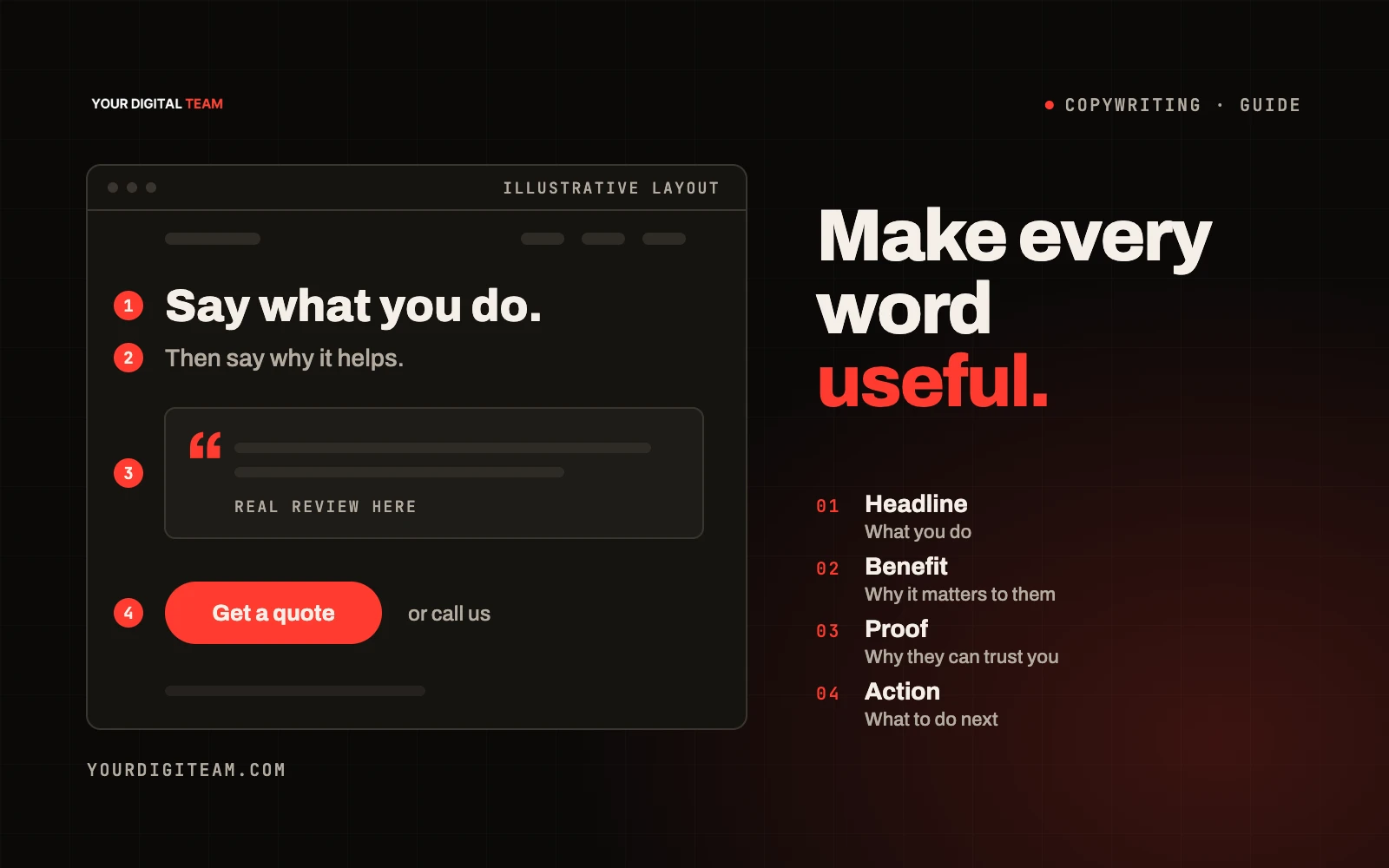
Every element of a well-designed website is doing a job. The headline tells the visitor exactly what they get and who it's for. The layout guides the eye toward the action you want taken. The whitespace prevents overwhelm. The social proof — reviews, client logos, case studies — arrives at exactly the moment doubt would otherwise win.
Bad design does the opposite. It creates confusion. Confusion creates hesitation. Hesitation creates exits.
Design is not what it looks like. It's whether a stranger can arrive, understand what you do, and decide to contact you — without having to work for it.
02 — Speed is design
A one-second delay in page load time reduces conversions by 7%.
That's not a developer problem — it's a revenue problem. Your website could have beautiful visuals and compelling copy and still be haemorrhaging leads because the images are uncompressed, the code is bloated, or the hosting is underpowered. Visitors don't wait. They have fifteen other tabs open and zero patience for a spinner.
Page speed is also a direct ranking signal for Google. A slow site doesn't just lose visitors — it loses visibility before those visitors ever arrive. Every second you shave off load time is a direct win for your SEO.
Illustrative performance figures; actual results depend on the website and test conditions.
03 — Mobile is where your customers actually are
Over 60% of web traffic comes from mobile. Most business websites were never tested on one.
On mobile, a poorly designed site becomes unusable. Navigation breaks. Text becomes unreadable. Buttons are too small to tap. Forms are impossible to complete. The customer gives up and calls your competitor, whose site works.
Mobile-first design isn't a trend. It's table stakes. If you're not sure how your site holds up, we wrote a full guide on making your site mobile-friendly.
04 — Trust signals have to be earned on the page
Buyers are sceptical. Your website is where they make their risk assessment.
Trust is built through specifics, not generalities. Not "we're passionate about what we do" — but the name of the client, the result you delivered, the before and after. Not "quality service guaranteed" — but a real photograph of your team, a real address, a real phone number that someone answers.
Design makes trust signals believable. Poor design makes them invisible.
05 — Your website compounds over time
A well-built website doesn't just convert visitors today. It keeps getting more valuable.
It ranks better on Google, earns more backlinks, generates more return visits, and becomes a more valuable business asset with every month that passes. An underperforming site does the opposite — it depresses your search rankings, drives up your cost per acquisition on paid ads, and quietly tells every visitor that your business isn't quite what they're looking for.
The businesses winning online aren't always the ones with the biggest budgets or the best product. They're often the ones who took their website seriously — who understood that design is not a cost, it's a multiplier.
That's the thinking behind every site we build. See how our web development works, or if you want to know what your current site is costing you, we'll tell you for free with a free review.
Illustrative growth figures, not a verified client case study.