13 min read
How Much Does a Website Cost in the UK?
 Written byThomas FitzgeraldFounder, Your Digital Team
WebsitesPublished 9 Sep 2026Updated
Want help putting this into practice? Explore our web design in Newcastle.
Real UK website prices by type, what drives the cost up, the hidden costs most quotes leave out, and how to tell if you're getting a fair deal.
According to Whito's 2026 UK pricing research, a professionally built website for a typical small business costs £3,000 to £6,000 excluding VAT. A five page brochure site costs £1,500 to £3,000 from a freelancer and £3,000 to £5,000 from an agency, while building it yourself on a builder such as Wix or Squarespace costs around £10 to £50 a month. Ecommerce sites start at about £5,000 and can pass £20,000, and Whito suggests budgeting at least £500 a year for running costs on top.
Include ongoing care in the decision by comparing website maintenance costs and the work a support plan actually covers.
If your business serves Gateshead, our web design for Gateshead businesses page explains how the website fits with the wider marketing plan.
Ask ten web developers what a website costs and you'll get ten different answers, most of them "it depends." That's true, but it's also useless if you're trying to budget.
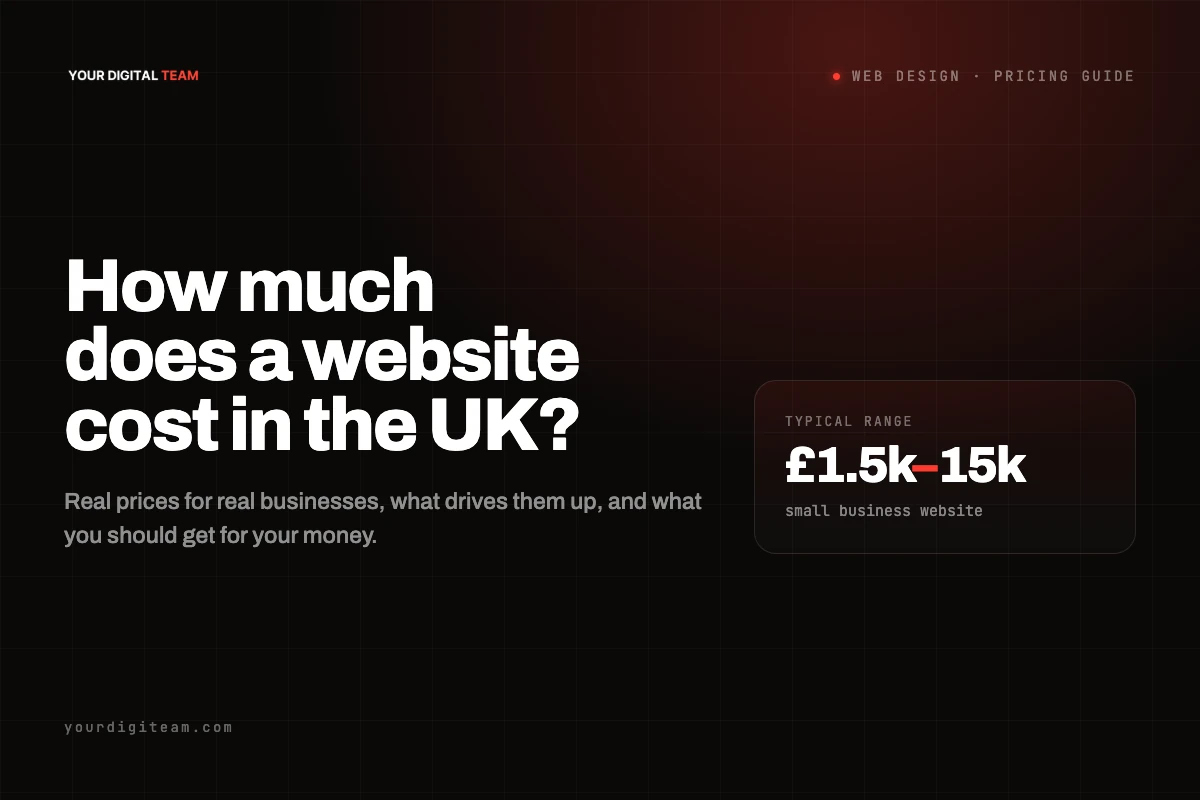
So here's the straight version. A professional website in the UK costs anywhere from £500 for a simple one-page site to £15,000+ for a custom e-commerce build. Where you land in that range depends on what you need it to do, not what it looks like.
Below is a full breakdown, the real price ranges by type, what drives the cost up, the hidden costs most people forget, and how to tell if a quote is fair.
01. The price ranges
What a website costs by type.
The UK market splits into four broad tiers. Each serves a different purpose and a different budget.
- One-page / landing, £500 to £1,500, Sole traders, event pages, a single service
- Small business site, £1,500 to £4,000, 5 to 10 pages, contact forms, blog, local SEO
- Brochure / professional, £4,000 to £8,000, Custom design, portfolio, booking, integrations
- E-commerce / custom, £8,000 to £15,000+, Online store, payment systems, product catalogue
These are for a proper build, designed, developed, and tested, not a template with your logo dropped in. If a quote is significantly below these ranges, ask what's been left out.
02. What moves the price
Six things that change the number.
- Number of pages. Each page needs design, content, and development. A 5-page site and a 25-page site are very different jobs.
- Custom design vs template. A template adapted to your brand is faster and cheaper. Fully custom design starts from a blank canvas and costs more, but it's yours.
- Functionality. Booking systems, payment gateways, membership areas, calculators, integrations with your CRM, every feature adds time.
- Content. Do you have the copy and photos, or does someone need to write and shoot them? Content is often the biggest hidden cost.
- SEO built in. A site built to rank, proper structure, fast load times, schema markup, costs more upfront but pays back in organic traffic. A site built without it is a brochure nobody finds.
- Platform. Squarespace and Shopify sites cost less to build than fully custom-coded sites, but have limits on what you can do. The right choice depends on what you need.
The cheapest website is the one that doesn't get built twice. Spend once on something that works.
03. The hidden costs
What the quote often doesn't include.
The build price is rarely the total. Here's what to budget for on top:
- Domain name: £10 to £30/year
- Hosting: £5 to £50/month depending on platform and traffic
- SSL certificate: Often included, sometimes £50 to £100/year
- Maintenance: Updates, security patches, backups, £50 to £200/month if you want someone else to handle it
- Content updates: Blog posts, new pages, seasonal changes, either your time or a retainer
- Marketing: A website is a shop with no customers unless people find it. SEO and paid ads are what bring them.
04. Is it worth it?
A website isn't a cost. It's an asset.
The question isn't "how much does a website cost", it's "how much does a website earn." A well-built site that generates two enquiries a month at £2,000 average job value has paid for itself inside a quarter.
The businesses that get this wrong aren't the ones who overspend. They're the ones who buy the cheapest option, get a site that doesn't convert, and then pay again 18 months later for the one they should have built first.
05. What we charge
How Your Digital Team prices web development.
We quote per project because every business is different. But to give you a sense: most of the sites we build for trades, local services, and small businesses sit in the £1,500 to £5,000 range, built on Squarespace or Shopify, with on-page SEO baked in from day one.
Every build includes mobile-first design, fast load times, proper structure for Google, and a walkthrough so you can update it yourself. See what's included or get a quote, we'll tell you honestly if a template site would do the job.
If you already have a site and want to know if it's worth keeping or replacing, we'll review it for free. Sometimes a fix is enough. Sometimes it's not. Either way, you'll know.
2026 update: what UK price guides say a website costs by type
The ranges earlier in this post are a starting point. It is worth checking them against independent UK guides too, because any quote you get will be judged against something. Here is how the main published sources break it down for 2026.
| Type of site | Typical UK cost | Source |
|---|---|---|
| DIY website builder (Wix, Squarespace and similar) | £10 to £50 a month | Whito |
| Builder plans, cheapest to top tier | £1.99 to £259 a month | Startups.co.uk |
| Template or theme | £0 to £400+ one-off | Startups.co.uk |
| Brochure site from a freelancer (5 pages) | £1,500 to £3,000 | Whito |
| Brochure site from an agency (5 pages) | £3,000 to £5,000 | Whito |
| Custom business site (15+ pages) | £5,000 to £15,000 | Whito |
| Ecommerce site | £5,000 to £20,000+ | Whito |
Whito's figures exclude VAT, so check whether each quote you get is shown with or without it.
A template does not make a site cheap on its own. Startups.co.uk points out that many builder themes are free, so the real cost is the time spent setting the site up, writing the pages and connecting your domain. For online shops, Bark's 2026 price guide puts ecommerce builds from £5,000, with the final figure depending on how many products you sell and which payment systems you need. If you are weighing up the two main builders for a shop, our Squarespace vs Shopify comparison covers the differences.
Freelancer, agency or DIY: where the money goes
Most of a build price is labour, so the hourly rate of whoever builds it matters more than the platform. These are the published UK rates:
| Who builds it | Hourly rate | Source |
|---|---|---|
| Offshore company | £10 to £25 | Startups.co.uk |
| Freelance web designer | £25 to £50 | Startups.co.uk |
| Freelancer | £40 to £70 (£35 to £55 outside the big cities) | Whito |
| Small web agency | £50 to £150 | Startups.co.uk |
| Large web agency | £75 to £200+ | Startups.co.uk |
Fasthosts sets the three routes side by side for a small to medium site:
| Website builder | Freelance designer | Agency | |
|---|---|---|---|
| Build cost | £5 to £50 a month | £1,000 to £5,000 | £3,000 to £10,000 |
| Ongoing costs | £50 to £100 a year | £100 to £1,000 a year | £300 to £2,000 a year |
How to choose between them:
- DIY on a builder suits a sole trader who needs a few pages, has time to write them and is happy to learn the editor. You pay in hours rather than pounds.
- A freelancer suits a small business that wants a professional brochure site without agency overheads. Check who covers you if they are ill or busy.
- An agency suits a business that wants design, build, SEO and ongoing support from one place, or a site with more pages and features. You pay more per hour for a team rather than one person.
What a website costs to run each year
The build is a one-off. The running costs come round every year, and they are easy to leave out of a budget. Whito's 2026 research gives these annual figures for a typical small business site:
| Running cost | Per year | Per month |
|---|---|---|
| Hosting | £50 to £300 | £4 to £25 |
| Domain renewal | £10 to £30 | £1 to £3 |
| SSL certificate | £0 to £100 | £0 to £8 |
| Plugins and themes | £50 to £300 | £4 to £25 |
| Maintenance and updates | £300 to £1,200 | £25 to £100 |
| Content updates | £0 to £500 | £0 to £40 |
| Total | £500 to £2,000+ | £50 to £200 |
On a builder such as Squarespace or Shopify, hosting and SSL are part of the monthly plan, so that plan replaces the first and third lines. Whito's advice is to budget at least £500 a year for running costs, and it found the median entry level care plan across 18 UK providers was £50 a month. For more on what a support plan should include, see our guide to website maintenance costs.
SEO is separate again. Startups.co.uk puts specialist SEO help at £150 to £1,200+ a month. Our own SEO plans start at £250 a month for about 10 hours of work, and all of them are listed on our pricing page.
Costs that catch people out
The previous section covered the basics. These are the extras that push a project past the price on the quote:
- Copywriting: £50 to £150 a page, according to Whito, or £250 to £750 for a five page site.
- Photography: £200 to £800 (Whito).
- Extra pages: £150 to £400 each beyond what was quoted (Whito).
- SEO setup: £300 to £1,000 (Whito).
- Transaction fees on shops: Startups.co.uk lists Shopify at 1.5% to 2% plus 25p, Wix at 2.1% plus 20p, and Squarespace at 0% to 7% plus card processing, depending on the plan.
- Apps and plugins: £0 to £100+ a month for extras such as email marketing tools (Startups.co.uk).
- Renewal prices: Startups.co.uk notes that some builders charge for the domain automatically after a free first year, and that paying monthly costs more than paying annually.
Whito estimates that hidden costs like these add 30% to 50% on top of the quoted price. Asking about each one before you sign is the simplest way to avoid that.
A worked example budget
This is an illustrative example, not a quote. It shows how the ranges above add up for a six page brochure site for a local trades business, built by a freelancer on a website builder. Each line is picked from within the published ranges quoted in this post.
| Item | Year one | Year two onwards |
|---|---|---|
| Design and build (within Whito's £1,500 to £3,000 freelancer range) | £2,000 | £0 |
| Copywriting, 6 pages at £100 a page | £600 | £0 |
| Photography | £400 | £0 |
| Domain name | £10 | £10 |
| Builder plan at £20 a month | £240 | £240 |
| Care plan at £50 a month | £600 | £600 |
| Total | £3,850 | £850 |
Two things to take from this. The build was only around half of the first year's spend, and the site still costs money every year after launch. If you add SEO at even the low end of the Startups.co.uk range, the yearly figure goes up by at least £1,800.
How to get website quotes you can compare
Prices are hard to compare partly because so few are published. When Whito checked 78 UK web design firms in November 2026, only 32 of them (41%) showed a price on their website. So you will usually need to ask, and the way you ask decides whether the answers line up.
- Write a brief first. List your pages, features, who supplies the words and photos, and any examples you like. Our website brief template gives you a ready made structure.
- Send the same brief to every supplier. Three is enough to see where the market sits.
- Ask for an itemised quote. Design, build, content, SEO setup, training and launch should each have a line.
- Check VAT. Confirm whether each price includes it.
- Ask about year two. Get the hosting or platform cost, domain renewal and any care plan in writing.
- Ask who owns what. The domain should be registered in your name, and you should be able to move the site if you leave.
- Check payment terms and revisions. Whito found 50% deposit and 50% on completion is typical. Ask how many rounds of changes are included.
If you would like a price for your own project, fill in our web design quote form and we will come back with an itemised figure.
Sources for this section: How Much Does a Website Cost in the UK? Web Design Prices 2026 (Whito), How much does a website cost for a small business? (Startups.co.uk), How much does it cost to build a website? (Fasthosts), How much does website design cost in 2026? (Bark).
Frequently asked questions
How much does a website cost in the UK?
Whito's 2026 research puts a professionally built small business website at £3,000 to £6,000 excluding VAT, with ecommerce sites from £5,000 to £20,000 or more. Bark's 2026 price guide gives a wider UK average of £500 to £5,000 for web design. DIY website builders cost far less upfront, at around £10 to £50 a month according to Whito.
How much does a 5 page website cost in the UK?
According to Whito, a five page brochure site costs £1,500 to £3,000 from a freelancer and £3,000 to £5,000 from an agency. The price moves with who writes the copy, whether you need photography and how much custom design is involved. Copywriting alone adds £50 to £150 a page if you do not write it yourself.
How much do web designers charge per hour in the UK?
Startups.co.uk lists freelance web designers at £25 to £50 an hour, small agencies at £50 to £150 and large agencies at £75 to £200 or more. Whito's 2026 figures put freelancers at £40 to £70 an hour, or £35 to £55 outside the big cities. Most designers quote a fixed project price, but the hourly rate is what sits behind it.
How much does a website cost to run each year?
Whito estimates running costs for a small business site at £500 to £2,000 or more a year, covering hosting, domain renewal, SSL, plugins, maintenance and content updates. A .co.uk domain is around £10 a year and maintenance retainers typically run £50 to £200 a month. SEO is extra, at £150 to £1,200 or more a month according to Startups.co.uk.
Is it cheaper to build a website yourself?
In cash terms, yes. Fasthosts puts a website builder at £5 to £50 a month with £50 to £100 a year in other running costs, against £1,000 to £5,000 for a freelancer build. The trade off is your own time, and a DIY site still needs good copy, photos and basic SEO to bring in enquiries.
How do I know if a website quote is fair?
Compare it against published UK ranges, and get at least two other quotes from the same written brief so you are comparing like with like. Ask for each item to be listed separately, check whether VAT is included, and get the yearly running costs in writing. A quote well below the published ranges usually means something such as content, SEO setup or revisions has been left out.
Thomas founded Your Digital Team to help businesses connect SEO, paid media, content and web development to measurable growth.
Meet Your Digital Team